

Even though Ruxandra Teslo’s essay Curing Cancer Won’t Redeem AI, is not presented as a Catholic argument, what makes the piece so important is that it moves the debate beyond the questions that now dominate almost every discussion about AI: whether it will eliminate jobs, increase productivity, create abundance, replace human tasks, or accelerate scientific discovery.
Those questions matter enormously, and I have argued repeatedly in The Imago Project that AI’s extraordinary potential in medicine is one of the strongest reasons not to embrace a simplistic “slow everything down” mentality. If artificial intelligence can help detect rare diseases earlier, discover new drugs, or cure cancers that remain lethal today, that would be an extraordinary human good.
Teslo does not dispute any of that. Her concern is deeper. She asks whether even spectacular material benefits would be enough to justify an AI future in which ordinary human beings gradually ceased to be meaningful participants in their own civilization.
In other words, would curing cancer redeem a technological order that made people safer, healthier, richer, and more entertained, but also less necessary, less autonomous, and less capable of shaping the conditions of their own lives?
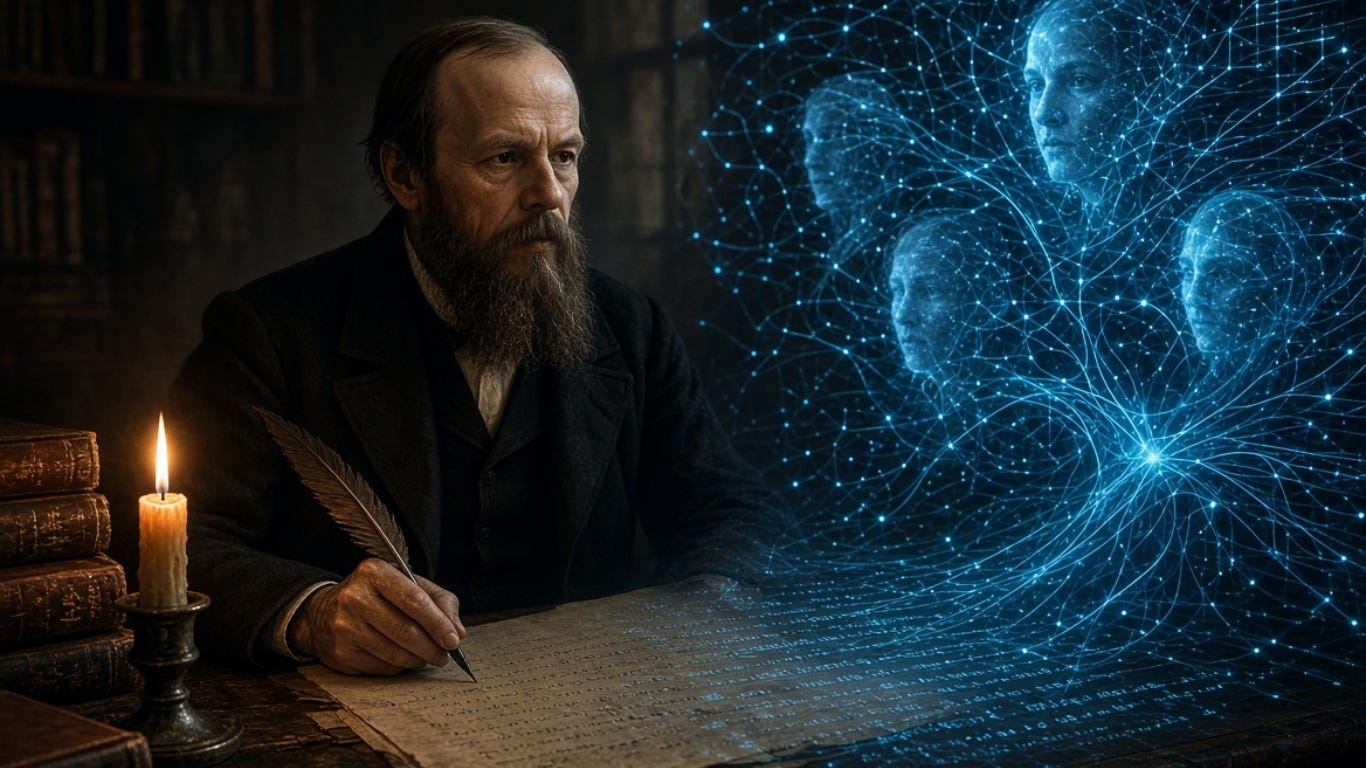
To explore that question, Teslo turns brilliantly to Dostoevsky’s The Brothers Karamazov, and especially to the famous parable of the Grand Inquisitor. Dostoevsky imagines Christ returning to earth during the Spanish Inquisition, only to be arrested by the Grand Inquisitor, who tells Him that His great mistake was to expect too much from human beings. Christ offered humanity freedom, while the Inquisitor believes that what people truly want is bread, security, certainty, and relief from the burden of choice. Freedom, in this vision, is too difficult. Feed people, protect them, entertain them, and remove uncertainty from their lives, and eventually they may willingly surrender the troublesome responsibility of being free.
Teslo sees an unsettling parallel in some contemporary visions of the AI future. We are promised extraordinary abundance, the conquest of disease, dramatically cheaper goods and services, freedom from drudgery, and intelligent systems capable of organizing ever larger portions of society more efficiently than human beings can.
But then she asks the question that should haunt the entire AI debate: “What if man does not, after all, wish merely to be fed, protected, entertained, and spared the burden of necessity? What if he also wishes to remain the author of his choices and circumstances?”
That is, in my view, the heart of the matter.
The question is almost unmistakably Christian. In the Gospel, Christ’s temptation in the desert includes the invitation to turn stones into bread. Christ does not deny that bread is good. He rejects the idea that bread is enough. “Man shall not live by bread alone.” Catholic anthropology likewise rejects any understanding of human flourishing that reduces the person to the satisfaction of material needs. We need food, health, shelter, security, and technological progress, and curing cancer would be an immense good. But human beings also need freedom, responsibility, relationships, vocation, participation, and the knowledge that their actions matter.
In other words, transcendence and meaning.
In that regard, Teslo notes that work provides people with more than income. It can give independence, social standing, belonging, responsibility, opportunities for advancement, and the experience of being genuinely needed.
That insight fits remarkably well with St. John Paul II’s teaching in Laborem Exercens, where he insisted that technology can be an authentic ally of humanity when it facilitates and enriches human work, but can become almost an adversary when it displaces the worker, deprives him of creativity and responsibility, or reduces him to a subordinate element within a larger system.
John Paul II’s famous principle was that work is “for man,” not man “for work.” But that insight cuts in more than one direction. It means that degrading or exploitative work must never be treated as the measure of human worth.
At the same time, it means that simply replacing meaningful participation with passive consumption does not necessarily solve the human problem. A society in which everyone receives material abundance while losing agency, vocation, and responsibility may be prosperous and still profoundly impoverished.
Teslo uses a deliberately ridiculous but memorable image to describe one possible post-AGI future: humanity as a collection of well-fed hamsters. Imagine a world in which AI produces abundance, almost nobody needs to work, medicine is superb, entertainment is infinite, and nearly every material need is easily met. Yet the important decisions are increasingly made by systems ordinary people neither understand nor meaningfully influence. Human labor is no longer economically necessary, human judgment is progressively displaced, and most people become beneficiaries of civilization rather than participants in building it.
Such people might be comfortable. The deeper question is whether they would be flourishing.
This is precisely where the Catholic contribution to the AI debate becomes indispensable. And let me remind you that the value of Catholic contribution to the AI conversation is something appreciated by a non-religious person and a technology titan such as Jaron Lanier. In fact, after attending a Vatican AI conference, Lanier admitted that the Catholic view of the human person is “vastly, vastly, vastly more sane and reasonable” than that of many in Silicon Valley
For the Catholic tradition, the human person is not fundamentally a consumer or merely a biological organism whose successful management consists in maximizing health, longevity, comfort, and entertainment. He is imago Dei, a creature made in the image of a Creator.
Human creativity, work, responsibility, freedom, and participation are therefore not flaws in the human condition that technological progress should eventually eliminate. They belong, in an important sense, to our dignity.
Teslo’s argument also suggests that perhaps we have been defining the problem of “AI alignment” too narrowly. We usually ask whether artificial intelligence will obey human instructions, respect safety constraints, or refrain from catastrophic behavior. Those are essential questions. But there is another alignment problem that may prove just as important: whether the AI economy itself can be aligned with a truthful, holistic understanding of the human person.
I remain fundamentally optimistic about artificial intelligence. I want AI researchers working aggressively on cancer, neurological disease, new materials, cleaner energy, better education, and technologies capable of reducing genuinely degrading labor. But Teslo is right that the deepest anxieties about AI cannot be answered simply by promising greater material benefits.
Eventually, the question “What happens to jobs?” becomes “What happens to human agency?” And beneath that lies an even more fundamental question: what do we believe a human being is for?
That is why Teslo’s essay is so important. Perhaps the greatest danger of artificial intelligence is not that machines somehow become human. It is that, surrounded by extraordinarily capable machines, we gradually accept a diminished definition of what it means to be human.
This reads like AI to me.