

Is not that Tyler Cowen always has the right answer when it comes to how to expand implementation of AI. He would probably be among the first to reject that description. What makes him particularly valuable is that he rarely treats AI ethics as an exercise in producing admirable principles that have little chance of surviving contact with technological reality.
His recent visit to Anthropic is a good example.
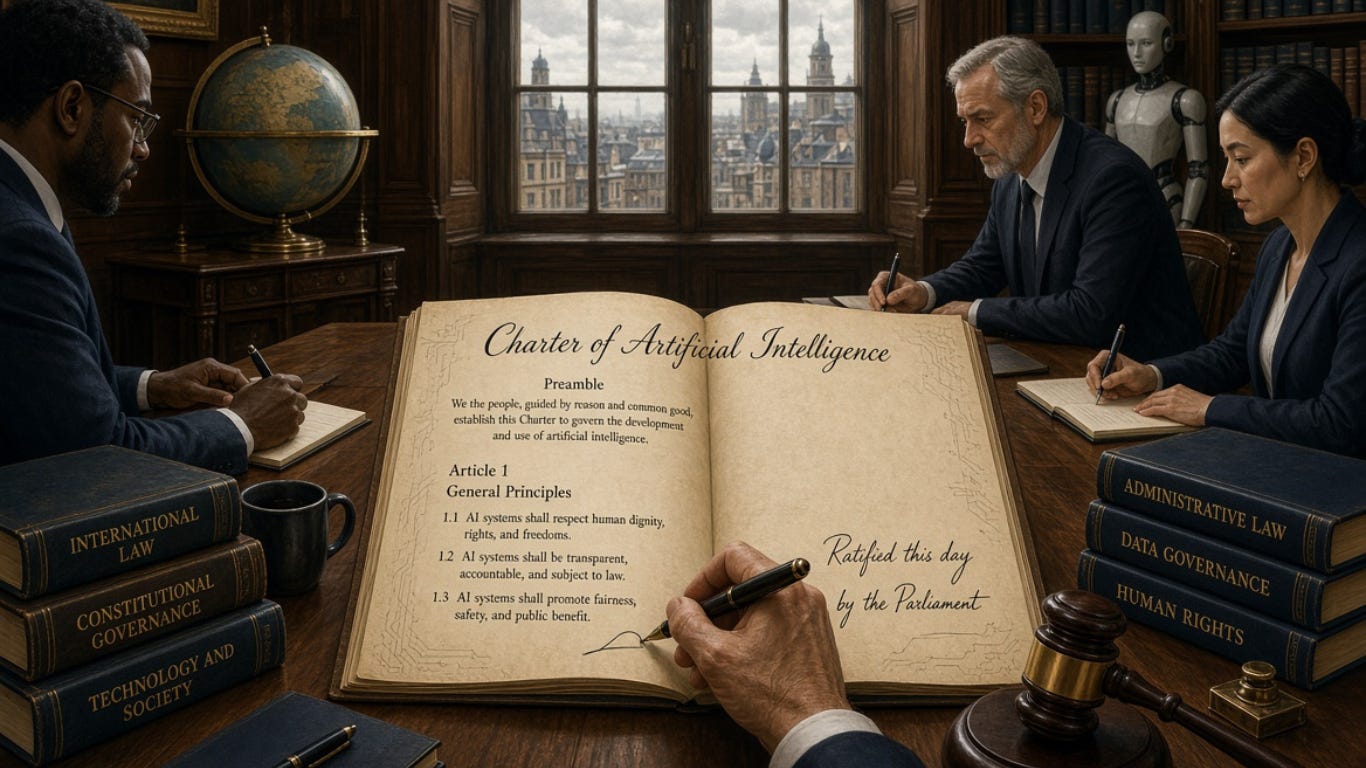
Cowen was invited to participate in a two-day discussion about rewriting the “constitution” governing Claude. Keep in mind that a Catholic priest, Fr. Brendan McGuire, participated in drafting the first Claude constitution. His principal suggestion was fascinating: instead of imagining an AI constitution merely as a fixed list of commandments, Anthropic should borrow from the traditions of common law and case law.
Or, as Cowen memorably put it, think not only in terms of “Torah,” (as in “Revelation”) but also “Talmud” (as in “Intepretation”)
Rules need interpretation. Difficult cases generate precedents. Precedents require commentary. New circumstances require distinctions that nobody anticipated when the original text was written.
Cowen therefore suggested developing a serious secondary literature around AI constitutions, using diverse AI systems to identify possible violations or “constitutional drift,” and creating a final panel of human adjudicators functioning somewhat like an independent judiciary.
For anyone approaching AI from a Catholic perspective, this is tremendously important.
I have repeatedly argued in The Imago Project that principles are indispensable; but principles alone are not enough. It is easy to say that AI must respect human dignity, autonomy, privacy, truth, justice, and the common good. The difficult question is: What institutions make those principles operational when billions of decisions are being made at machine speed?
An especially thoughtful response Cowen subsequently received from Scott Jenkins helps move the discussion another step forward.
Jenkins identifies four problems that any such AI “judicial system” would immediately confront.
First is sheer scale. Human judges operate at human speed; AI systems generate billions of interactions. If humans can review only a microscopic fraction of difficult cases, formal oversight could become almost theatrical unless automated systems help identify the cases that genuinely require judgment.
Second is what Jenkins calls doctrinal bloat. A rapidly accumulating body of precedents and exceptions could eventually become contradictory and unintelligible.
Third, even a supposedly diverse panel of AI reviewers could share the same blind spots because the systems were trained on similar data or architectures.
And finally comes perhaps the most important problem: the “Hollow Court.” What happens when an independent AI judiciary reaches a conclusion that conflicts with the commercial interests of the corporation paying for it? If the adjudicators possess no meaningful authority, ethics becomes decoration.
These are exactly the questions the AI debate needs.
They are not arguments for abandoning ethical governance because it is difficult. Nor are they proposals for imposing such cumbersome regulatory structures that companies simply ignore them, relocate, or race ahead elsewhere.
Catholic moral thought has never been satisfied merely with announcing ideals. Prudence asks how the good can actually be pursued under concrete circumstances, among imperfect people and imperfect institutions. And Catholic realism understands that power needs accountability precisely because neither corporate executives, government regulators, nor ethical boards suddenly cease being human when entrusted with enormous responsibility.
The most promising approach to AI ethics may therefore look less like writing the perfect manifesto and more like constructing a workable constitutional order: principles, precedents, interpretation, checks and balances, independent judgment, and mechanisms capable of adapting as circumstances change.
That is why Cowen is worth following.