

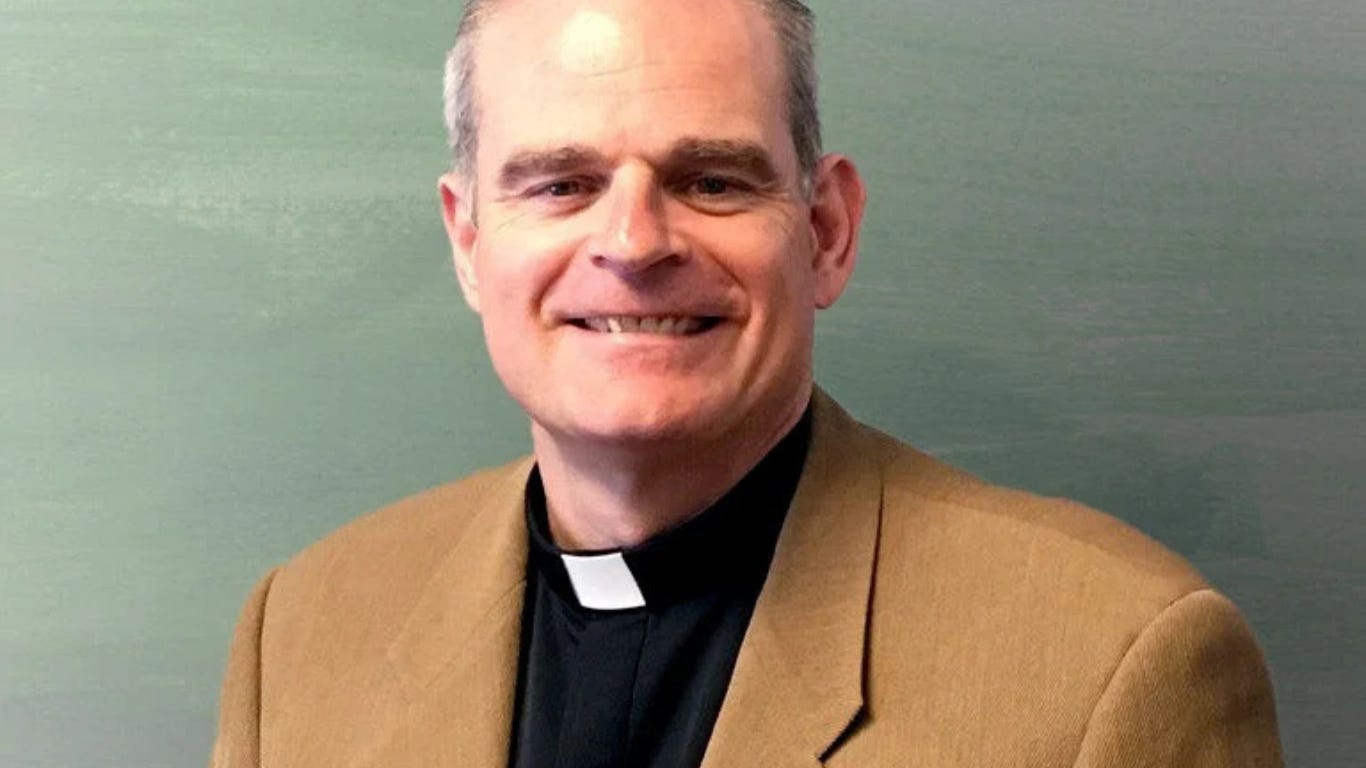
Fr. Brendan McGuire
Fr. Brendan McGuire is, as I posted some time ago, a very important character in incipient but fruitful conversation between the Catholic church and those on the front line of artificial intelligence.
One of the most important observations he made in a conversation with Vatican News, is that the Church–tech conversation over AI is no longer a curiosity. It is becoming a real, structured, and increasingly mature dialogue. That matters because for too long the relationship between Silicon Valley and the Church could be dismissed as occasional symbolism: a conference here, a photo-op there, a few executives seeking moral cover. McGuire’s account suggests something deeper is now taking shape: a sustained conversation, nearly a decade in the making, rooted in listening, friendship, and a genuine search for wisdom.
That is what makes his testimony so significant. Fr. McGuire is not speaking as an outsider trying to comment on the tech world from a safe distance. He is a former engineer with a master’s degree in computer science and cybersecurity, now a priest in Silicon Valley, who has remained in close contact with leaders in the industry for years.
He describes how tech figures began coming to him not with triumphalism, but with anxiety—some worried by what they saw emerging, others asking what could be done. Out of that came listening sessions, deeper collaboration with Bishop Paul Tighe and the Dicastery for Culture and Education, the creation of the Institute for Technology, Ethics and Culture at Santa Clara University, and an expanding effort to accompany those shaping the future.
From a Catholic perspective, that is exactly the right development. The Church should neither flatter the industry nor retreat from it. She should do what Fr. McGuire describes: stay close enough to understand the real problems, morally serious enough to name them, and humble enough to become a trusted partner rather than a scolding spectator.
His language of a shared “search for wisdom” is especially important, because it points to what Silicon Valley often lacks most. The industry has no shortage of intelligence, capital, speed, or ambition. What it lacks is wisdom about the human person, moral limits, and the difference between what can be built and what should be built.
That is also why Pope Leo XIV’s Magnifica humanitas matters in this story. McGuire sees the encyclical not as the start of the conversation, but as a new intensification of a long journey. In other words, the Church is no longer merely reacting to AI from the outside. She is trying to speak into its development while there is still time, so that her contribution may be, as the article puts it, “more incisive and immediate.” That may prove decisive. A Catholic contribution to AI will matter only if it is not merely beautiful in principle, but present at the points where actual systems, companies, and norms are being formed.