

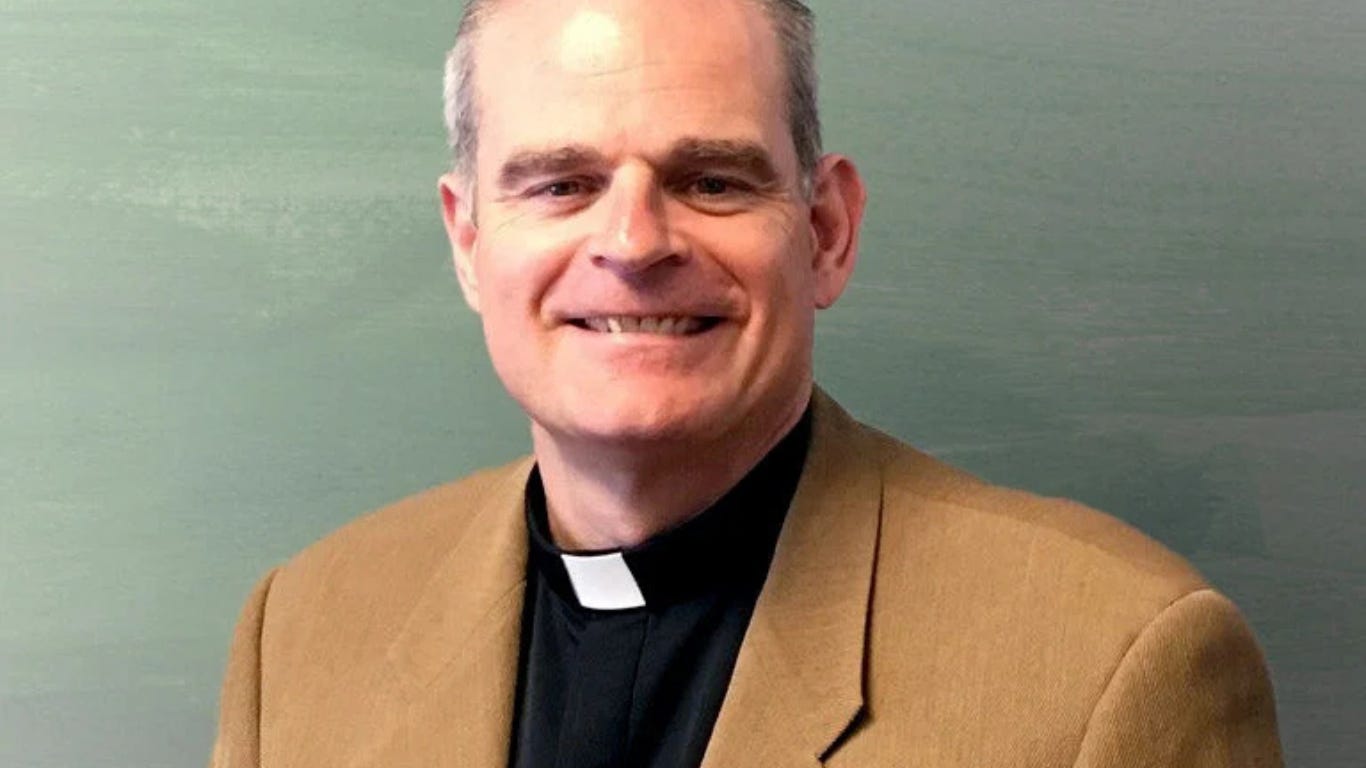
Father Brendan McGuire, Pastor at St. Simon Parish, Author of “The Soul of AI”
One of the more striking signs of the age is that even the builders of artificial intelligence now seem to know, at some level, that code alone is not enough.
In a fascinating recent piece for Observer, young journalist Alexandra Tremayne-Pengelly tells the story of Father Brendan McGuire, a Catholic priest with a Silicon Valley background who helped Anthropic think through the ethical architecture behind its A.I. system, Claude.
According to Tremayne-Pengelly’s reporting, McGuire and other Catholic voices were brought in to help shape Anthropic’s “Claude Constitution,” the principles meant to guide how the system behaves. McGuire said the company was asking for “direct help from the Vatican” because the industry was moving so quickly.
That should get every serious Catholic attention.
For years, modern culture tried to persuade itself that moral reasoning could be detached from theology, that human dignity could survive the collapse of any serious account of the human person, and that technological progress would somehow regulate itself. That fantasy is breaking down in real time. When the architects of A.I. start reaching for priests, theologians, and the language of conscience, it is because they have run into an old truth: you cannot build human-centered technology if you no longer know what a human being is.
Tremayne-Pengelly reports that McGuire spoke of helping make the model “more discerning,” and added, “I think we have to help these machines be tilted towards good.”
That is an arresting phrase. Of course, a machine cannot possess virtue in the way a human soul can. It has no conscience in the strict sense, no capacity for repentance, no moral agency before God. But the people training these systems are still making choices about what those systems will reward, imitate, normalize, refuse, or amplify. And those choices are moral choices, whether Silicon Valley likes the word or not.
This is where Catholics need to be both sober and confident.
Sober, because there is a real temptation to speak about A.I. in quasi-religious terms. The danger here is not just hype. It is anthropological confusion. If we begin to treat synthetic fluency as personhood, or predictive power as moral insight, we will not elevate the machine. We will degrade the human being.
But Catholics should also be confident, because this debate is not alien territory for the Church. Catholic thought has been wrestling for centuries with reason, will, virtue, law, truth, formation, and the ends of human life. In other words, with precisely the questions the tech world now realizes it cannot avoid.
The central Catholic claim is not complicated. Human beings are made in the image of God. That means our dignity is not earned by utility, speed, novelty, market value, or computational capacity. It is intrinsic. Any technology worthy of man must begin there. If it does not, it may still be profitable. It may still be impressive. But it will not be humane.
That is why this story matters. Not because a priest advised a tech company. And not because one firm may be more ethically serious than its competitors. It matters because it reveals that the deepest questions posed by A.I. are finally forcing our culture back toward first principles.
And first principles are exactly where the Church is strongest.
Alejandro,
Thank you for this thoughtful piece. Your insight about the parallels between the early web moment and what we now face with AI resonates deeply. The Church has always been at her best when she engages new realities with both faith and intellectual courage. I look forward to continuing this conversation.
God bless,
Fr. Brendan