

In my recent post, “A Catholic Anti-AI Manifesto,” I responded to the emerging group of Catholic writers and influencers who are moving beyond caution about artificial intelligence toward something approaching categorical rejection.
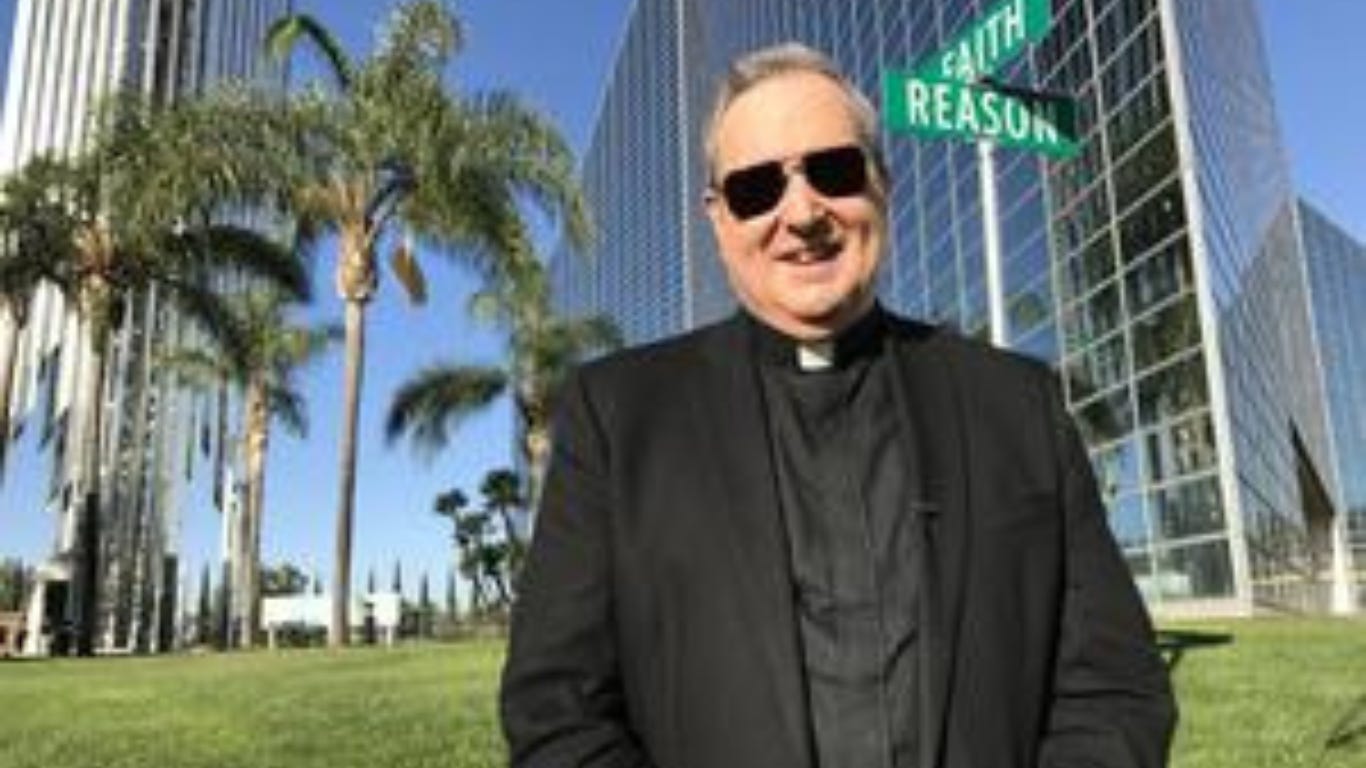
Now Fr. Robert J. Spitzer, SJ, has entered the discussion with what I think is an exceptionally useful clarification.
And importantly, he begins by conceding that many of the anti-AI movement’s concerns are legitimate. He takes seriously the danger of chatbots presenting themselves as though they possess empathy, friendship, care, morality or genuine interpersonal understanding.
As Spitzer puts it bluntly: “AI will never be human,” since AI does not possess self-consciousness in the human sense, spiritual awareness, genuine moral agency or free action. And therefore there is real danger when children or adults begin relating to a simulation machine as though another human person were present.
Spitzer also accepts the broader concerns Pope Leo XIV has raised: autonomous weapons, damage to education, student intellectual laziness, privacy, concentrated technological power and the possibility of AI systems encouraging deeply destructive behavior.
So this is not an argument from technological optimism, but from Catholic moral theology.
And here Spitzer makes the distinction that matters most: generative AI is not intrinsically evil.
Certain human actions are evil by their very object. Spitzer cites abortion, experimentation on unborn children and physician-assisted suicide. No circumstance or good intention can transform such acts into something morally acceptable. Well, AI does not belong to that category.
Some uses of AI can certainly be immoral. Some may produce grave and even irreversible harm. But using generative AI does not necessarily violate human dignity or cause injustice.
Therefore, Spitzer concludes, Catholics remain free to use it… with prudence, caution and moral restraint.
That may sound obvious, but it cuts directly through much of the present debate. There is an enormous difference between saying: “AI can be used for evil” and saying: “using AI is evil.”
The first proposition is plainly true. The second has no basis in Catholic teaching.
Spitzer then makes another point that deserves much greater emphasis in Catholic discussions: we cannot conduct an ethical evaluation of AI by cataloguing only its dangers.
The technology is already accelerating scientific research, helping discover new materials, advancing clean-energy research, assisting food and water technologies, improving communications and performing tedious work far faster than human beings could accomplish it.
In scientific fields, he argues, AI can sometimes compress work that once might have required extraordinary amounts of time. That potential creates moral responsibilities of its own.
If a technology can help cure disease, expand access to education, increase productivity, reduce drudgery or solve problems involving food, energy and clean water, then refusing to consider those goods is not moral seriousness. It is an incomplete moral analysis.
This is precisely why the Catholic position cannot be reduced to just “beware of AI;” it must also ask: What good can we accomplish with it?
Spitzer’s proposal closely resembles the two-track approach I have been arguing for in The Imago Project.
We need strong protections against genuinely dangerous applications: independent oversight, limitations on technological monopolies, prohibitions against delegating irreversible life-and-death decisions to machines, protection of workers from being treated as disposable and particular safeguards for children and vulnerable people.
But alongside those guardrails, Catholics should actively participate in shaping the technology.
Spitzer specifically calls for Catholic developers and ethicists to help schools, parishes, businesses and families understand how to use AI responsibly.
And he points to his own MagisAI project as an example of Catholic engagement: an AI designed to assist Catholic education and evangelization by answering questions about God, Christ, the Eucharist, Scripture, morality, Mary and the intellectual claims of the faith.
This is particularly significant given one of the claims I criticized in my previous post: the demand from some Catholic anti-AI voices that Catholic AI projects should simply be taken down.
Spitzer offers the opposite answer: Build better ones; and build them according to a truthful anthropology. Do not pretend the machine is a person. Do not encourage emotional dependency. Do not surrender human moral judgment to it.
But use the technology where it can genuinely serve truth and human flourishing. In the words of Fr. Spitzer: “Catholics may choose to avoid AI completely, but they should not therefore call it evil.”
As Fr. Spitzer argues, much closer to the balance Pope Leo XIV is attempting to establish:
AI will not become human.
It must not replace human moral agency.
It can do great harm.
And it can accomplish genuine good.
Catholic wisdom begins by being capable of holding all four propositions at the same time.