

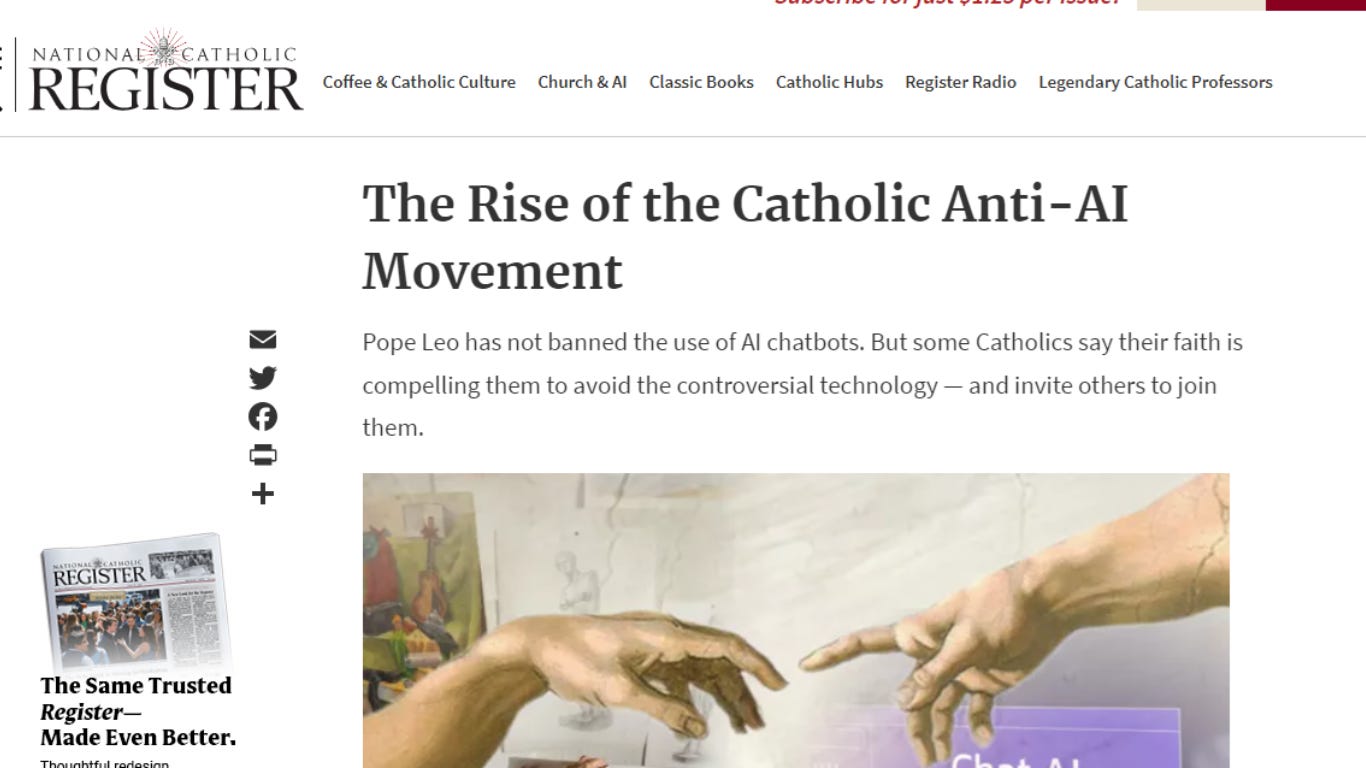
After reading a fascinating recent article in the National Catholic Register, “The Rise of the Catholic Anti-AI Movement,” one gets the impression that such a manifesto may already be writing itself.
The article by my friend and colleague Jonah McKeown brings together a number of Catholic writers, intellectuals, artists and social-media personalities who have moved well beyond caution about artificial intelligence. Their emerging position is much more radical: generative AI, and especially conversational AI, is something Catholics should reject.
Some of their arguments deserve serious attention.
They worry that outsourcing intellectual work to machines will weaken the human capacity to think. Artists object that generative images imitate creativity without possessing the human intentionality from which genuine art emerges. Others point to the enormous environmental and energy demands of data centers, the danger AI poses to children, the possibility that simulated relationships will intensify loneliness, and the broader tendency of technological culture to substitute artificial experiences for real human ones.
All of these are legitimate concerns, but some members of this emerging movement go considerably further.
Matthew Walther, founder of The Lamp, has described AI as an evil that people should reject. Marc Barnes of New Polity argues that AI chatbots are themselves evil because conversational interaction with something that is not a person involves the user in an irrational act. He has even called for Magisterium AI, the Catholic platform built around Church documents, to be deleted. Other Catholic critics regard AI-generated sacred art as a dangerous intrusion into Catholic worship and culture.
And Eliza Monts, one of the movement’s most visible advocates, compares these early days of Catholic resistance to AI with what she has read about the beginnings of the American pro-life movement. She points to mounting public opposition to data centers and generative AI as evidence that resistance is beginning to coalesce.
Based on what I have already written regarding AI and Catholicism, I think such a position deserves attention, and there is absolutely nothing wrong with a Catholic deciding that AI is not good for him or her.
A person may conclude that ChatGPT weakens his concentration, that generative images offend his artistic sensibilities, that smartphones damage his prayer life, or even that contemporary technology as a whole makes it more difficult for him to live virtuously. He or she is free to walk away.
Indeed, Catholicism possesses a long and beautiful tradition of radical renunciation. The hermit leaves goods behind that are perfectly legitimate for others because he believes his own vocation requires something different. Monks voluntarily renounce possessions, marriage and aspects of ordinary social life—not because those things are evil, but because renunciation can itself become a path toward God.
In other words, families can decide to live without smartphones. I personally know and love many of them. My two favorite godsons belong to such families. Also, writers can refuse AI and artists can use only physical media. Such decisions may cultivate attention, craftsmanship, silence, presence and human communion.
But as much as Catholicism has plenty of room for technological ascetics, it does not have a theological basis for converting a personal ascetical choice into a universal moral prohibition.
That is an entirely different claim.
Here is where I part company decisively with the emerging anti-AI movement. A Catholic may reasonably say: I believe using conversational AI would be harmful to my intellectual or spiritual life. He or she cannot therefore conclude: Your use of AI is sinful.
Nor can he or she establish that Catholics attempting to integrate artificial intelligence into education, medicine, scholarship, evangelization or Catholic intellectual life are somehow betraying the faith simply because they have chosen engagement rather than abstinence.
There is currently no such teaching of the Church. More importantly, the direction of Pope Leo XIV’s teaching points elsewhere.
Magnifica Humanitas contains extensive warnings about artificial intelligence, but the encyclical explicitly refuses to frame the choice as one between enthusiasm and fear. Instead, Leo speaks of human creative intelligence as a gift capable of alleviating suffering and opening new possibilities and says that genuinely humanizing technological development can be embraced responsibly.
And Pope Leo made the same distinction even more clearly this past Friday, August 21, addressing Catholic legislators gathered to discuss “Human Dignity and Artificial Intelligence.”
Their task, he told them, is “not to hinder innovation but to guide it wisely.” Sound law should encourage technological creativity while protecting human dignity, rights, privacy and democratic institutions.
That is essentially a two-pronged Catholic approach: Beware and engage.
There is another irony here that is difficult to ignore. Some of the strongest Catholic critics of artificial intelligence quoted in the Register’s article are themselves extremely sophisticated users of digital media.
They publish online, build audiences on social networks, master the ever-changing algorithms of social media, produce podcasts and videos and distribute essays instantly around the world using technologies that would have been almost unimaginable a generation ago.
There is nothing wrong with that. I do exactly the same. But it raises an obvious question. Why did these technologies become morally acceptable while AI suddenly crosses some metaphysical Rubicon?
Christians expressed profound anxieties about the internet when it became widespread in the 1990s. And they were not entirely wrong. Pornography exploded. Human relationships changed. Attention became fragmented. Social media later produced new forms of addiction, manipulation and political tribalism.
Yet imagine if Catholics had concluded in 1995 that the appropriate response was simply to abandon the internet. No Catholic websites, no online catechesis, no myriad of ministries (from Catholic Answers to “Bible in a Year” to Catholic journalism distributed globally at negligible cost.)
The internet’s dangers did not disappear because Catholics participated in it. But Catholic participation made it possible for the Gospel to inhabit a cultural space that was going to exist whether Catholics approved of it or not.
The Church has repeatedly confronted technologies that radically changed human communication.
The printing press made possible the rapid dissemination of errors and heresies on an unprecedented scale. It also became one of the greatest instruments for spreading Scripture, theology, catechesis and Catholic culture.
Radio and television brought vulgarity, propaganda and commercial manipulation into the home. They also made possible extraordinary forms of evangelization. Just think of the upcoming beatification of Fultin Sheen.
The internet gave humanity pornography, misinformation and addictive social networks. But it also gave us instantaneous access to Scripture, the Fathers of the Church, papal documents, theological libraries and Catholic communities spanning continents.
Catholics who entered these new environments did not thereby endorse every consequence of the technology. They evangelized culture.
I know AI has its very unique challenges and complexities. That’s always the case with new technologies. In the end, I believe that history will settle part of this argument, and I do not mean that in the Hegelian sense.
Hegel’s famous formulation Die Weltgeschichte ist das Weltgericht (“world history is the world’s judgment”) is not my theology. History does not determine moral truth. Something does not become good simply because it triumphs technologically or culturally.
What I mean is that history teaches. And it teaches repeatedly that technologies possessing enormous practical usefulness are extraordinarily difficult to abolish. Attempts at complete cultural rejection usually fail. The more important question becomes who shapes the technology, which values become embedded within it and toward what ends it is ultimately directed.
That is where I believe Catholic energy should be concentrated. We need Catholics studying, criticizing and producing AI.
What we do not need is an invented doctrine according to which refusing AI represents fidelity while engaging it represents compromise.
Especially when the actual Magisterium is saying something rather different. On August 21, Pope Leo offered Catholic legislators what may be the clearest concise formulation yet of his approach:
“Dear friends, the world does not need an artificial intelligence that diminishes humanity; rather, it needs human intelligence enlightened by wisdom, political authority guided by conscience and technological innovation directed by charity. Only then will artificial intelligence become not a rival to humanity but a servant of the common good.”
That is the Catholic position I can wholeheartedly join: going where the culture is and trying to bring Christ with them.