

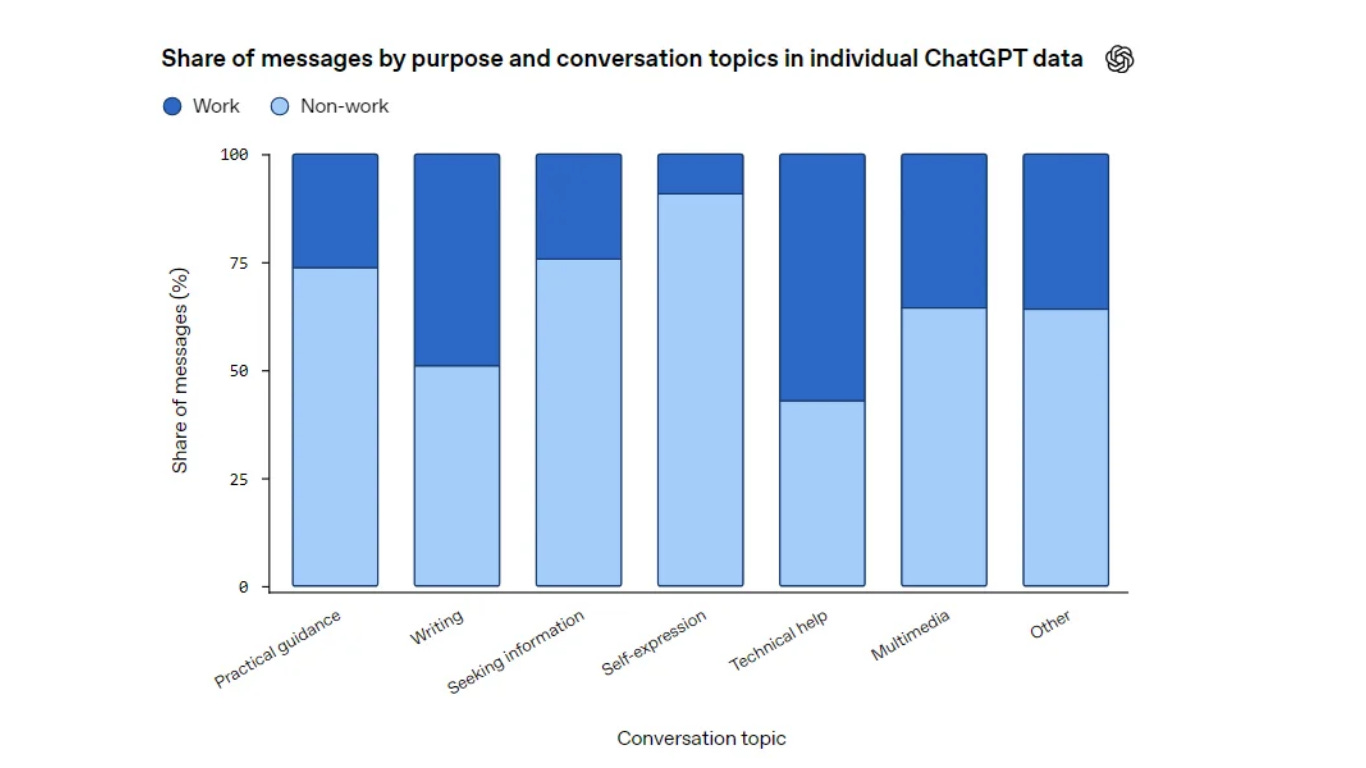
A new report published by OpenAI on October 26, titled ChatGPT’s Expanding World of Work, offers an unusually detailed look at how artificial intelligence is being incorporated into professional activities around the world. Its findings suggest that AI is no longer simply a convenient tool for writing emails, summarizing documents, or answering questions. It is becoming part of an increasingly diverse range of tasks, crossing professional boundaries and potentially transforming the nature of many jobs.
But does this mean that AI will generate a new era of employment, creativity, and economic prosperity? Or are we witnessing the beginning of a profound displacement of human labor, with consequences that we are still unable to measure?
The answer, at least for now, is that we simply don’t know. And there are good reasons to be cautious.
The new OpenAI research examines ChatGPT usage across 165 categories of professional activity in nearly 100 countries, covering the period from the first quarter of 2025 through the third quarter of 2026. These activities range from preparing educational materials and developing marketing campaigns to programming, analyzing business data, and producing specialized professional content.
One particularly revealing finding is that the use of ChatGPT for work is becoming progressively less concentrated in a handful of familiar activities. Across 74 countries consistently represented in the data, the ten most common professional activities accounted for 56% of classified work-related messages in early 2025. By the third quarter of 2026, that proportion had declined to 51.1%.
This might seem like a modest change, but it suggests something important: AI is spreading beyond its original uses and becoming relevant to increasingly specialized forms of work.
Two earlier OpenAI studies help explain the potential consequences of these findings. In July, researchers examining more than 800,000 messages from American ChatGPT users found that 43.5% of messages involving occupation-specific tasks concerned activities traditionally associated with a different profession. When routine activities common to many occupations were included, the figure was 16.8%.
In other words, AI is allowing individuals to undertake work that previously might have required someone with a different professional specialization.
A small-business owner can develop advertising materials without hiring a marketing consultant. A journalist can perform preliminary data analysis without needing a dedicated analyst. An entrepreneur can produce basic visual materials without contracting a graphic designer.
This is potentially wonderful news for individuals and small businesses that have traditionally been unable to afford specialized services.
But, as I explained in The Catholic debate we need, the same phenomenon creates a problem that enthusiastic advocates of AI often overlook.
If a small business can now perform internally what previously required hiring three outside specialists, we can celebrate the savings and increased independence of that business. But what happens to the professional opportunities of those three specialists?
Another OpenAI report, published in April, attempted to estimate how different occupations might be affected. Its framework, covering approximately 148 million American jobs, identified 18% as facing relatively high automation risk, 24% as likely to undergo substantial reorganization, 12% as potentially benefiting from employment growth, and 46% as facing less immediate change.
These figures are not predictions of actual unemployment. Nevertheless, they illustrate that AI’s effects will be highly uneven.
And perhaps the most troubling possibility is that significant occupational disruption could occur without an immediate, dramatic increase in unemployment. Companies might simply stop hiring junior employees, eliminate entry-level positions, or gradually reduce their workforce through attrition.
An entire generation could discover that the traditional first steps into professional life have become considerably harder to find.
How do we deal with the uncertainty
In his 1981 encyclical Laborem Exercens, St. John Paul II described human work as a fundamental dimension of man’s existence. Technology, he recognized, can be a powerful ally of labor, increasing productivity, reducing physical burdens, and improving the quality of what human beings produce.
But he also warned that technology can become an enemy of the worker when it deprives human beings of employment, creativity, responsibility, or personal fulfillment.
The distinction remains extraordinarily relevant today, and even if it is not mentioned that specifically in Magnifica Humanitas, Pope Leo makes very clear the ambivalence of AI and the required prudence to deal with it.
In January 2025, the Vatican published Antiqua et Nova, a document on the relationship between artificial and human intelligence that addresses precisely these concerns.
The document recognizes AI’s potential to increase productivity, create employment, and allow workers to concentrate on more creative tasks. But it also warns that the same technology can diminish professional skills, impose new forms of workplace surveillance, and subordinate human beings to the demands of increasingly powerful machines.
Perhaps its most important observation concerns the possibility that AI will be used primarily to replace employees rather than complement their work. In that scenario, technological progress could concentrate economic benefits among a relatively small number of individuals and companies while imposing substantial costs on workers and their families.
This is not an argument against AI. It is an argument against assuming that greater productivity automatically produces greater human flourishing.
History offers legitimate reasons for optimism about technological innovation. Agricultural mechanization, industrial development, electricity, and computing eliminated countless individual tasks while helping create new industries and occupations.
But history also teaches that the benefits of innovation are rarely distributed equally or immediately.
Additional questions
Artificial intelligence introduces another uncertainty: unlike many earlier technologies, it is advancing directly into activities once considered distinctive expressions of educated human intelligence.
Writing, programming, research, analysis, design, and administrative judgment are no longer insulated from technological substitution simply because they require higher education.
There is also a deeper concern. If AI reduces the need for junior professionals to perform foundational tasks, how will those professionals acquire the experience necessary to become tomorrow’s experts?
A lawyer does not become a great lawyer merely by supervising software that prepares legal documents. A journalist does not become an accomplished reporter solely by editing machine-generated articles. Professional excellence requires practice, judgment, mistakes, correction, and experience.
An economy that automates too much of that apprenticeship risks eventually undermining the very human expertise upon which its sophisticated technologies depend.
The October 26 OpenAI report does not establish that artificial intelligence is producing an employment catastrophe. But neither does it demonstrate that the expanding use of AI will translate into a corresponding expansion of human employment.
What it demonstrates is that the transformation of professional activity is already underway, spreading across national boundaries and penetrating an expanding range of occupations.
The consequences for jobs, wages, professional formation, and family stability remain uncertain.
For Catholics, the ultimate measure of AI’s success cannot be how much work machines can perform without us. It must be whether their extraordinary capabilities allow more human beings to live, work, create, support their families, and flourish with dignity.
And until we have convincing evidence that this is actually happening, caution is not pessimism. It is prudence.