

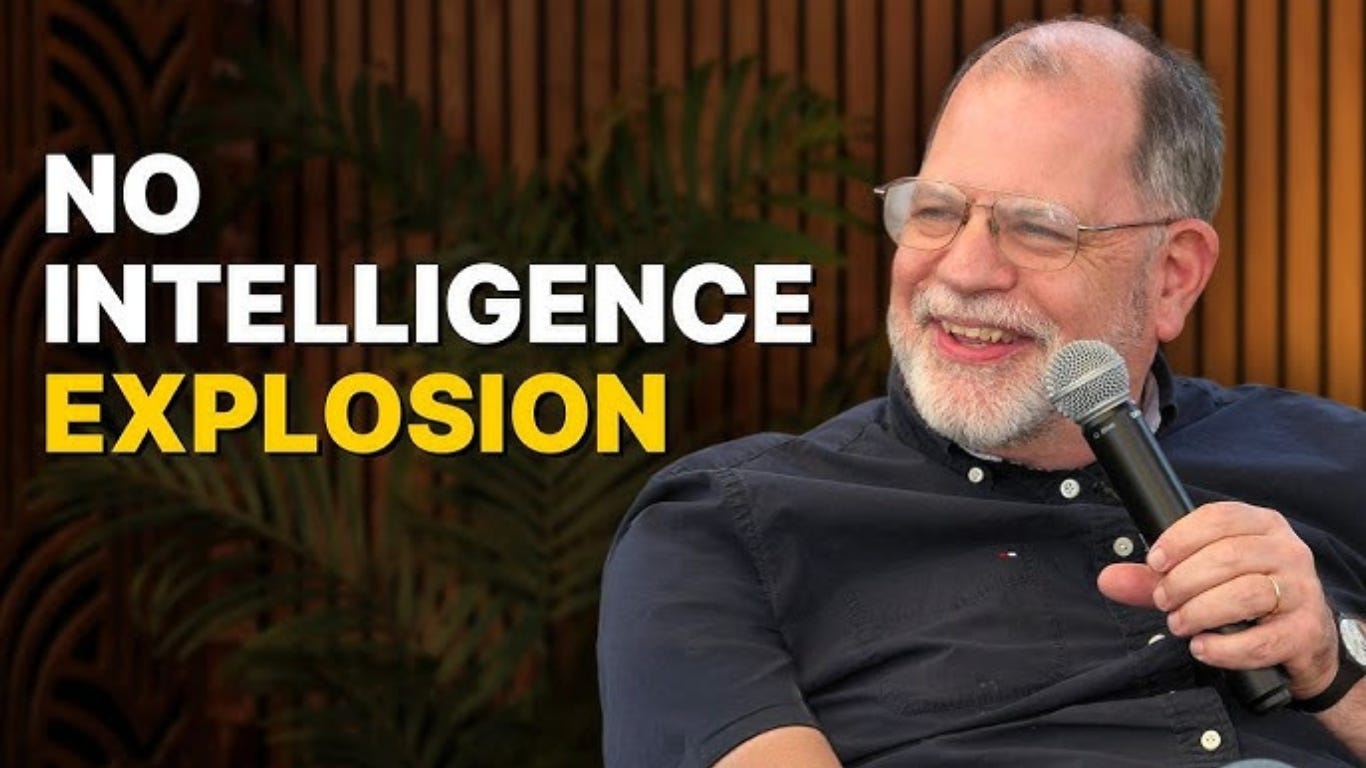
Tyler Cowen
Tyler Cowen’s tongue-in-cheek list of “seven ways” to avoid losing your job to AI is funny because it is true. His advice points in a clear direction: do work that is messy, embodied, relational, experimental, data-rich, and not easily reduced to a repeatable sequence at a screen. He says to look for “messy jobs,” to be wary of fully remote work, to become proficient with AI tools, to move toward fields like biomedicine, to run experiments, to gather data, and to seek more hands-on work.
In short: become more human where the machine is weakest, and more useful where the machine is strongest.
That is a sharper insight than the humor might suggest. Cowen’s list assumes that the safest future will belong less to the worker who simply sits at a terminal repeating standardized cognitive tasks, and more to the person who can move through the world, deal with unpredictability, test ideas in reality, gather fresh information, and interact with other human beings in concrete settings. That fits with his broader view that AI is more likely to create transitional disruption than permanent mass unemployment.
From a Catholic perspective, the striking thing is how much this sounds like a return to reality. If Cowen is even partly right, then the AI age may reward not disembodied cleverness alone, but presence, judgment, flexibility, and contact with the stubborn facts of the created world.
The joke hides a serious anthropological point: the more machines master abstract routine, the more valuable become those forms of work rooted in the body, in relationships, and in the unpredictability of real life.
There is something almost providentially ironic in that. A civilization that spent decades treating screen-based, standardized, white-collar work as the summit of prestige may now discover that many of the safer and more meaningful roles are those involving hands, presence, care, experimentation, and human adaptability.
Catholics should recognize the pattern. The dignity of work was never confined to the keyboard. The human person is not just a processor of information. He is an embodied being made for prudence, relationship, and action in the world.
So Cowen’s article works as comedy, but it also works as a warning. If you want to be less replaceable, do not become more machine-like. Become less so. Learn the tools, yes. But also move toward the kinds of labor where reality still pushes back, where other people still matter, and where intelligence must be joined to presence, character, and judgment. That is not just a strategy for surviving AI. It may also be a clue to recovering a saner vision of work.