

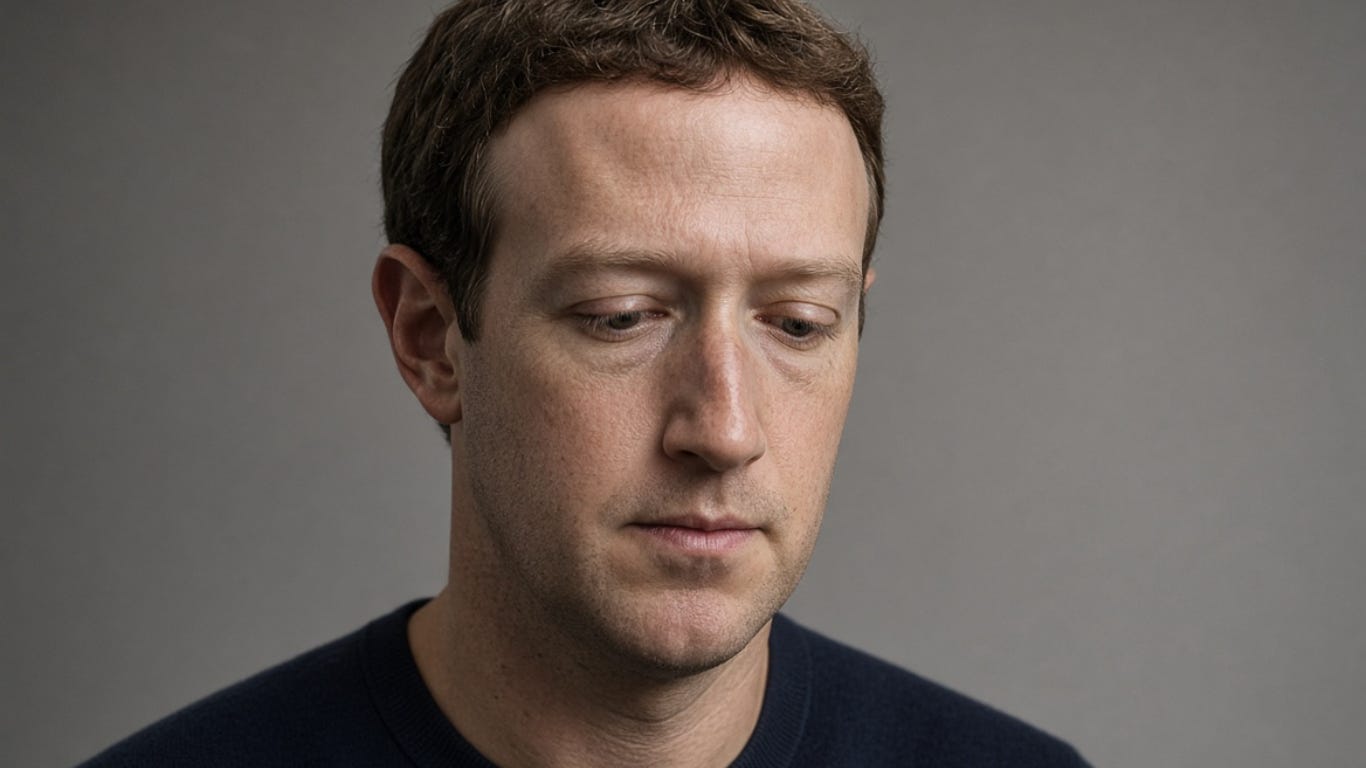
Mark Zuckerberg has entered the increasingly crowded field of AI manifestos with an ambitious declaration titled The Future Is for Everyone. It is long, optimistic, sweeping… but at times so sugary that one begins to suspect that Meta’s public-relations department was serving dessert.
Still, beneath all the rhetoric there is an argument worth taking seriously.
Zuckerberg’s case can essentially be reduced to basic economics and political realism: concentrated power produces monopoly-like advantages, while distributed capability encourages competition and spreads those advantages throughout the economy.
Applied to artificial intelligence, his argument is straightforward. If only a handful of governments or corporations possess extremely powerful AI, those institutions will acquire enormous advantages over everyone else. If, instead, increasingly capable AI becomes cheap and widely accessible, millions of individuals, entrepreneurs, researchers, and small companies will be able to use the same technology to compete, invent, and create.
That part of the manifesto makes sense.
Indeed, from a Catholic perspective, there is something attractive about it. Catholic social teaching has always been suspicious of excessive concentrations of power, whether political or economic. Subsidiarity favors empowering persons, families, communities, and smaller institutions rather than automatically transferring power upward to gigantic centralized structures.
But then comes the frosting.
Much of the manifesto wanders through optimistic descriptions of personal empowerment, creativity, relationships, health, education, community benefits, individual aspiration, and a future in which almost everyone becomes more capable of realizing his dreams. Some of this may prove true. But page after page of technological sunshine does little to answer the anxieties ordinary people actually have about AI. Most importantly, it ignores the proven dark side of humanity, something Catholics call “original sin.”
Zuckerberg argues that there will ultimately be “an abundance of jobs,” that AI will create occupations we cannot yet imagine, and that companies may become smaller while the total number of companies increases.
I hope he is right.
But that is less an answer to the employment problem than a bet on human economic adaptation.
The question haunting millions of workers is not whether economists can imagine new occupations appearing eventually. It is what happens between the disappearance of today’s job and the arrival of tomorrow’s hypothetical one. In other words, for a significant number of today’s workers, it is all about the transition.
A Catholic approach cannot judge technological progress merely by whether aggregate productivity eventually rises. The worker is not an adjustment cost. The time between technological displacement and economic reinvention is lived by actual human beings with mortgages, marriages, children, obligations, fears, and dignity.
And then there is Zuckerberg himself.
This is perhaps the manifesto’s greatest practical weakness: the messenger.
Zuckerberg wants Americans to believe that Meta has suddenly emerged as the champion of distributing power away from large institutions and toward ordinary individuals. One can appreciate the intellectual argument while recognizing how extraordinary that sales pitch sounds coming from the founder of one of the most powerful technology corporations in human history.
To be brutally clear: A 2025 Pew survey found that roughly two-thirds of Americans viewed Zuckerberg unfavorably, while Meta’s history includes the FTC’s record $5 billion privacy settlement; and as recently as August 2026, 61% of Americans told Reuters/Ipsos they favored stronger oversight of social-media companies. .
Therefore Meta surely understands why some people might raise an eyebrow… or both.
This becomes especially problematic when the manifesto adopts an almost philanthropic tone. Zuckerberg may sincerely believe that personal superintelligence will empower billions of people. I have no reason to claim otherwise. But sincerity is not the same thing as credibility.
This is where Catholic realism becomes particularly useful. We should judge Zuckerberg’s proposal neither according to our affection nor our dislike for Zuckerberg. The principle itself deserves consideration: distributing AI capabilities broadly may indeed be preferable to allowing a tiny oligopoly of corporations or governments to control the most powerful technology of our age.
But Catholic realism also reminds us that economic power does not cease being power merely because those possessing it speak the language of empowerment.
“The Future Is for Everyone” cannot merely mean that everyone gets access to the machine.
It must also mean that the economic order surrounding the machine remains genuinely ordered toward everyone.
That is the part of the manifesto that still needs to be written.