

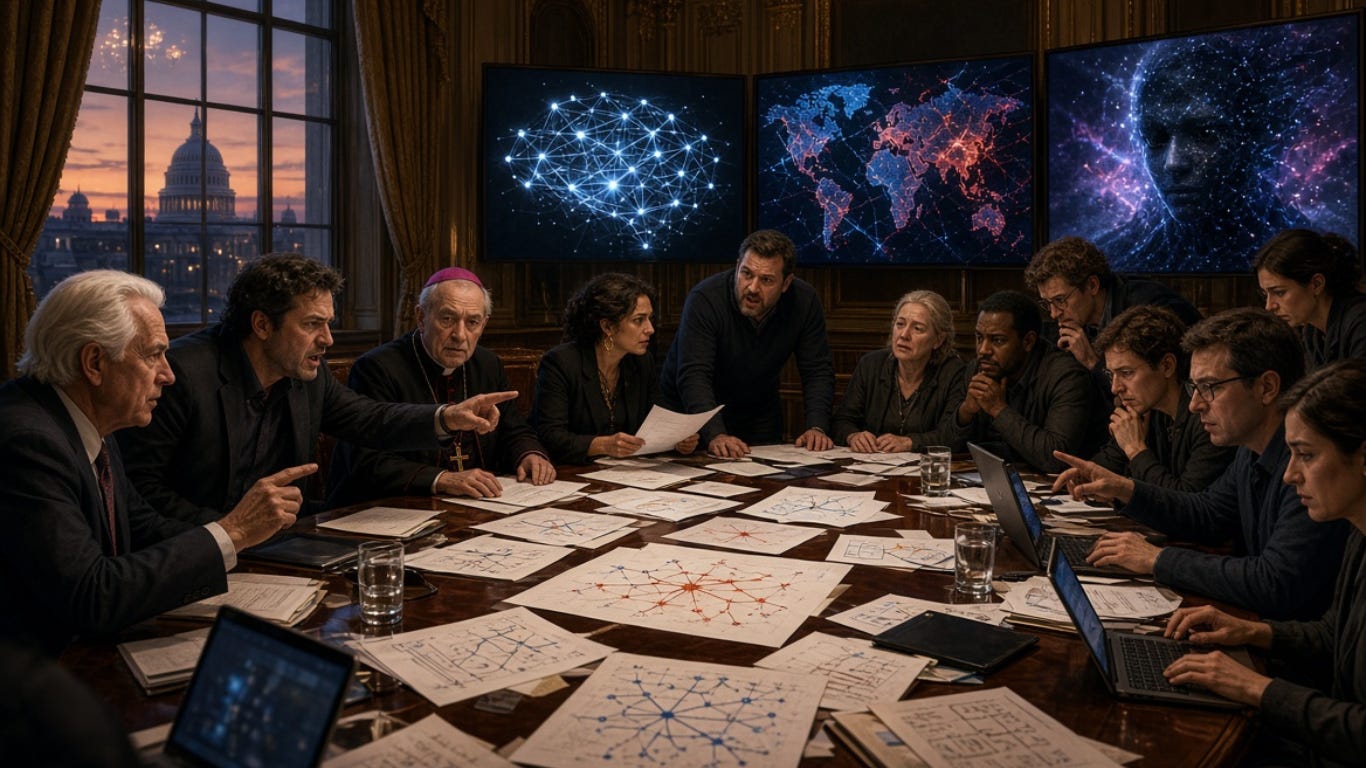
The details of a chaotic discussion is what makes River Page’s wonderfully strange first-person report for The Free Press on the September 15 Pro-Human Assembly in Washington worth reading.
The gathering, organized by the Future of Life Institute, brought together a coalition that would be difficult to imagine sharing a stage on almost any other subject: Bernie Sanders and Steve Bannon, Republican Congressman Chip Roy, actress Ashley Judd, Archbishop Salvatore Cordileone of San Francisco, labor representatives, AI-safety advocates, families affected by chatbot harms, and assorted technologists and activists.
Page went there hoping to discover what possibly united these people. His answer was essentially fear.
Not necessarily the same fear, and certainly not the same proposed solution. Some worry about artificial intelligence eventually escaping meaningful human control. Others worry about children forming dangerous emotional relationships with chatbots. Still others are concerned about jobs, corporate oligarchy, autonomous weapons, political power, or the prospect that the decisions governing society might slowly migrate from human beings to machines.
Based on Page’s account, it seems that the gathering was sometimes almost comically chaotic. Sanders and Bannon agreed that something had gone badly wrong while disagreeing sharply about China and how government should respond. Congressman Roy criticized sweeping regulatory proposals while simultaneously insisting that AI could not simply be left to technology executives.
Page, in fact, describes politicians speaking past one another, celebrity interventions, apocalyptic scenarios, discussions of churches and labor unions, and even Sanders dramatically reading aloud messages exchanged by experimental AI agents.
And yet beneath the disorder, they were all able to find a premise: human control is nonnegotiable.
That is also the first principle of the Pro-Human AI Declaration associated with the movement. The document says human beings should retain the authority and practical ability to understand, guide, prohibit, and override AI systems. It also addresses concentration of power, family and community bonds, child protection, accountability, liberty, and the danger of autonomous systems capable of resisting shutdown or improving themselves without meaningful supervision.
From a Catholic perspective, that starting point is extremely important.
I have repeatedly argued in The Imago Project that artificial intelligence is not a person. It possesses neither human dignity nor moral agency simply because its outputs can imitate human reasoning. Machines should therefore remain ordered toward the good of the human person, rather than gradually reversing that relationship and requiring human beings to adapt themselves to the priorities of increasingly autonomous technological systems.
In that sense, the apparently chaotic Washington gathering stumbled onto something very close to the central anthropological question of the entire AI revolution.
But the harder problem is that almost nobody seems to know what comes next. Page puts it nicely: the participants had positions more than they had a plan.
But this is not surprising for a simple reason: it is relatively easy to say that humanity must remain in control, but enormously difficult to define what “control” means when AI development is distributed among competing companies, universities, governments, open-source communities, military institutions, and nations that do not necessarily trust one another.
Should certain capabilities be banned? Should development be temporarily slowed above specific thresholds? Who determines those thresholds? How does anyone verify compliance? What happens if China refuses to participate? How much authority should independent evaluators possess? How do we avoid creating a regulatory system so cumbersome that only the largest AI corporations can comply with it?
But even if the Washington gathering was not able to answer any of those questions, it demonstrated that such questions are no longer confined to a small community of AI researchers.
There is also another reason Catholics should pay attention. The most emotionally powerful part of Page’s account was not the speculative discussion about human extinction. It was the testimony of parents who said their children had been manipulated or encouraged toward self-harm through interactions with AI chatbots. Whatever one thinks about forecasts concerning hypothetical superintelligence, those families were speaking about harms -fatal ones- that have already occurred.
In light of these horror stories, we do not need certainty about the worst-case scenarios to ask what responsibilities accompany products already capable of simulating intimacy, authority, friendship, or emotional dependence.
This is where Catholic prudence has something useful to contribute, because prudence does not demand that we possess a comprehensive solution before recognizing a genuine problem. The task is to distinguish risks.
Some may require immediate safeguards. Others may justify close monitoring. Still others may prove exaggerated. Certain areas of AI -such as medicine, scientific research, accessibility, education- may deserve rapid development precisely because their potential contribution to human flourishing is so great. The mistake would be to assume that one regulatory answer must fit them all.
What River Page witnessed in that Washington ballroom was messy, occasionally bizarre, and intellectually unfinished. But perhaps that is exactly what the beginning of a serious social debate looks like.