

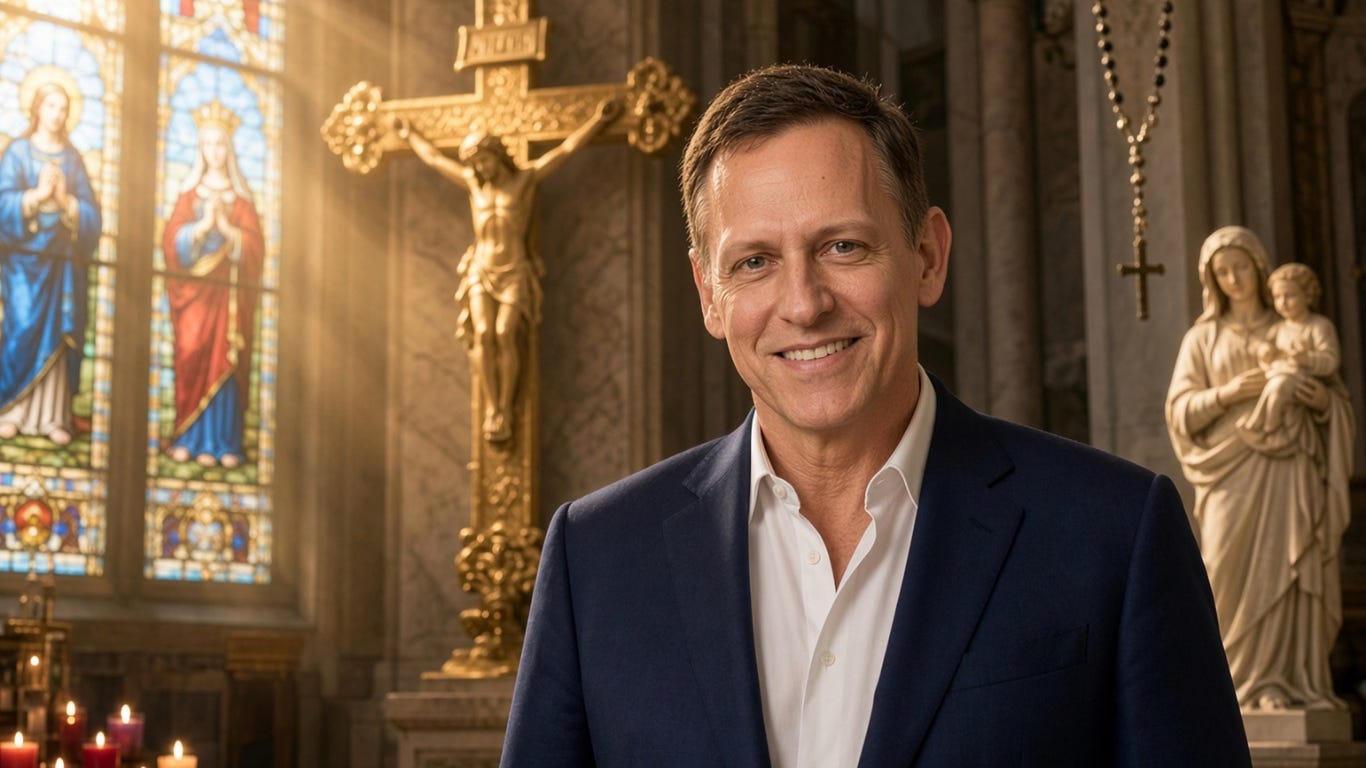
To many, calling Peter Thiel a “Catholic thinker” is a stretch. The tech mogul is the man behind large enterprises like Palantir, one of the “Mufasas” of the planet, and he himself claims to be a “Christian.” But someone that have read, understood, been mentored by, and claims to be a disciple of René Girard cannot be discarded from the increasingly complicated Catholic planet.
His latest long interview with Mathias Döpfner, highlighted by Tyler Cowen as “one of the very best Peter Thiel outputs,” is absolutely inevitable for anyone who wants to debate and even fiercely oppose Thiel’s ideas.
Thiel ranges widely across AI, technological stagnation, Europe, China, longevity, democracy and even the Christian meaning of eternal life. What emerges is a distinctive defense of technological progress that is neither conventionally secular nor straightforwardly Catholic.
Again, Thiel is not a Catholic. His religious beliefs have often been heterodox and difficult to classify. But his intellectual debt to Girard -the French Catholic thinker who taught him at Stanford- is enormous. Thiel has spent decades promoting Girard’s work, helped establish Girard’s theory of Imitatio to advance mimetic theory, and has repeatedly acknowledged how deeply Girard shaped his understanding of Christianity, violence, rivalry and modernity.
So when I describe something “Catholic” in Thiel’s approach, I do not mean that he represents Catholic doctrine. He certainly does not. I mean that some of his deepest intuitions come through a thinker whose anthropology was profoundly Christian and Catholic… and that those intuitions lead Thiel to conclusions about technology that deserve attention from Catholics.
His starting point is his famous stagnation thesis. For roughly two decades, Thiel has argued that Western civilization experienced far less technological progress after the 1970s than it liked to imagine. We became extremely good at manipulating bits (such as computers, software, the internet,) but progress in the physical world slowed dramatically. Nuclear power, transportation, aerospace, construction, energy and many other fields seemed to lose the extraordinary momentum they had possessed in the first half of the twentieth century.
Now, AI has forced Thiel to modify that thesis: he currently believes artificial intelligence may be “bigger than the internet” and powerful enough to restart genuine economic and technological acceleration.
But what interests me most is why he thinks that matters. For Thiel, stagnation is not simply disappointing economics. A society that stops believing the future can become better becomes increasingly zero-sum. If parents no longer expect their children to live better lives, politics becomes a struggle over distributing a limited pie rather than cooking a much larger one. Social conflict, resentment and pessimism increase.
Girard is not an easy read. But I think reading him is more indispensable than ever. That idea has an interesting Girardian undertone. Girard understood how rivalry intensifies when people converge upon the same objects of desire. Thiel’s technological optimism can therefore be read partly as an attempt to escape the mimetic trap: growth, invention and abundance create new possibilities rather than forcing everyone into increasingly bitter competition over existing ones.
This is not a complete Catholic theory of technological progress, but it is worth pondering.
Catholics can sometimes speak as though prudence means slowing things down. But prudence does not mean stagnation. Human creativity itself is good. Man is made in the image of a Creator, and our ability to discover, invent, heal and transform the material world is part of our vocation. The Catholic problem with technology begins not when human beings create powerful tools, but when those tools cease to be ordered toward the integral good of the person.
Thiel’s latest comments become especially interesting because he does not deny AI’s catastrophic risks. He concedes that the probability of losing control of advanced AI might conceivably be 5 or 10 percent and admits that such numbers would be very serious. His disagreement is with the conclusion that risk therefore necessarily requires slowing everything down. The alternative to technological development, he argues, is not a neutral world of tranquility and social harmony. Stagnation itself carries dangers.
That is a useful corrective to some of the debate I have been following in The Imago Project. Risks must be compared with risks. The harms of developing AI recklessly are real, but so are the harms of foregoing technologies capable of curing disease, increasing productivity, expanding scientific knowledge and raising standards of living. Technologies that, precisely for that same reason, are in a very real sense unstoppable.
Where I absolutely part company with Thiel is in some of his rhetoric.
He describes Pope Leo XIV’s AI encyclical as effectively helping China because Western societies may heed papal warnings while the Chinese Communist Party obviously will not. Thiel even uses the deliberately provocative phrase “useful idiot.” Here Thiel clearly needs a refresher of who the Pope is in the Catholic universe and what his ministry is about.
Magnifica Humanitas is not an anti-technology manifesto. Pope Leo has repeatedly argued for engagement, responsible development and technological innovation ordered toward the common good.
But beneath Thiel’s -mostly misguided- polemic with the Pope is a question that cannot be dismissed: what happens if the democratic West imposes restrictions upon itself that its strategic competitors do not observe?
That is precisely why the Catholic answer cannot simply be “slow down.” It has to be far more intelligent and strategic than that. There is significant consensus, especially of late, when it comes to the “slow down”.
But perhaps the most revealing moment in Thiel’s interview comes near the end, when the conversation turns to longevity and transhumanism.
Thiel rejects the idea that uploading a simulation of himself into a computer would amount to survival. He describes his position as “Christian-informed” and insists that personal identity is inseparable from our embodied existence. A software copy would not be him. And in a wonderfully Thielian twist, he says the problem with transhumanism, viewed from Christianity, is not that its ambitions are too extravagant but that “it didn’t go far enough.”
But before we disqualify him as the “Dr. No” of the first quarter of the 21st century, Thiel - rightly so- points out that Christianity promises not indefinite digital simulation but resurrection: the transformation of the whole person, body and soul.
And here is where I find Thiel most interesting -at least intriguing- for Catholics.
He is not simply saying that technology will save us. In fact, his Christian anthropology prevents him from accepting the most radical Silicon Valley fantasy; which is that enough computation can somehow recreate the human person.
Technology extending life, curing dementia or increasing abundance may transform civilization… but none of that equals salvation.
I am at the bottom in the pyramid of Catholic thinkers addressing these issues, but I dare to propose that a Catholic position should be capable of sharing something of Thiel’s technological optimism without accepting technological messianism.
We should resist the fashionable assumption that caution is automatically virtuous and acceleration automatically reckless. Sometimes refusing to develop a beneficial technology can itself have grave human consequences.
At the same time, Catholics know something technological optimists can forget: progress has no built-in moral direction. Greater power does not necessarily produce greater wisdom and a betterment of humanity, and technological abundance cannot answer the ultimate questions of human existence.
Thiel, for all his provocations, seems to understand at least part of this. His Girardian Christianity makes him suspicious both of apocalyptic fear and of secular utopianism. He sees human beings as dangerous, mimetic creatures wielding increasingly powerful technologies, but he also refuses to conclude that the answer is simply to stop creating.; and there is something worth recovering in that tension.
Catholic engagement with AI should neither worship the future nor fear it. We should build, invent and discover because human creativity is good, while remaining clear that technology is a servant and never the measure of the human person.
Peter Thiel may not be a Catholic thinker, but Catholics thinking seriously about AI should probably keep listening to him.