

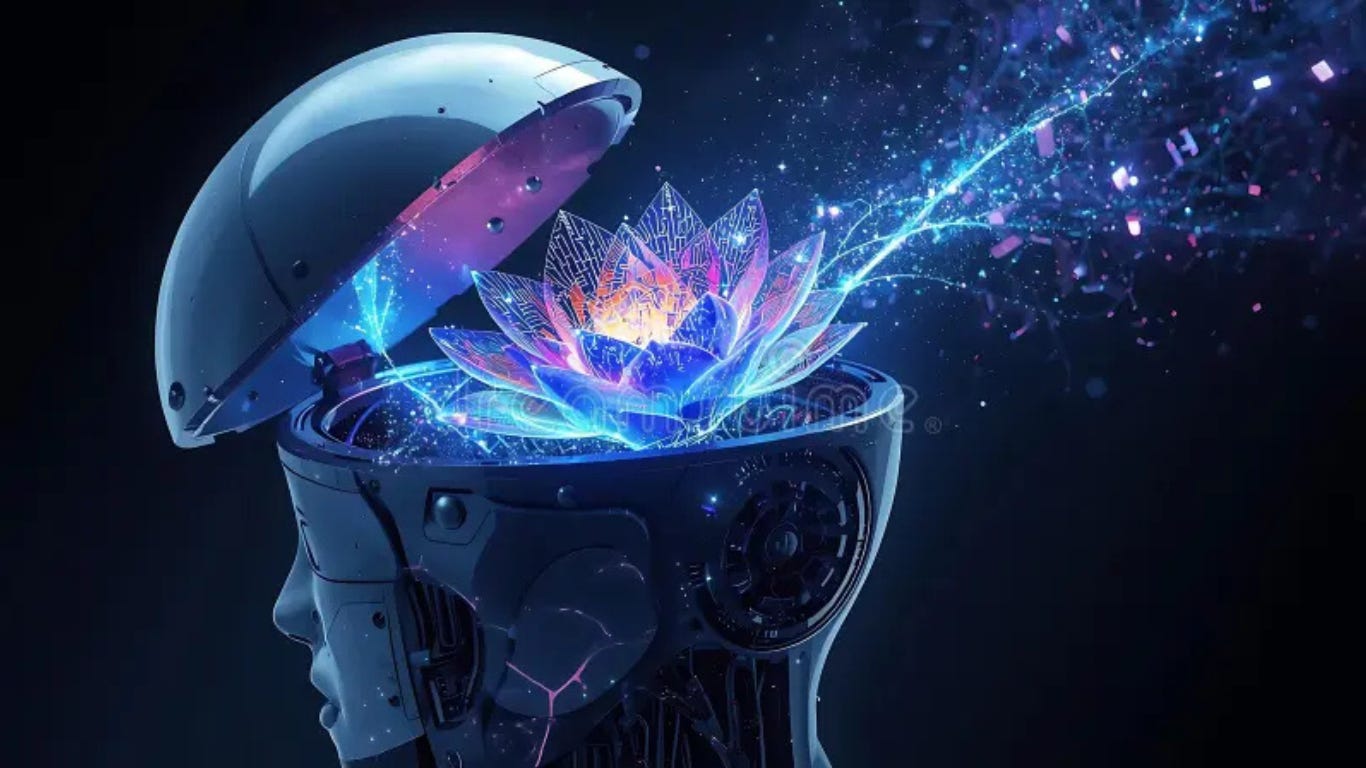
A recent essay by the Center of Digital Philosophy makes a serious philosophical claim: current AI may simulate many outward signs of mind, but that is not the same as instantiating consciousness; that is, actually bringing into being a real subject of experience -a unique human ability-.
The paper argues that computation, by itself, is an abstract description imposed on physical processes, not yet a sufficient account of lived awareness. On that view, AI can imitate the map without becoming the territory.
That is a useful corrective at a moment when some developers and commentators are tempted to speak as if generative AI were already approaching human consciousness.
Even Anthropic’s own research on “introspection” is much more limited than the hype suggests: it reports only some degree of introspective awareness in current Claude models, says that this capacity is highly unreliable and context-dependent, and explicitly states that the results do not tell us whether Claude or any other AI system is conscious, nor whether it introspects in the same way or to the same extent that humans do.
From a Catholic perspective, that matters. Human consciousness is not just clever output, internal monitoring, or persuasive linguistic performance. The human person is an embodied creature with intellect, will, moral agency, and a spiritual destiny that no artifact can simply replicate by becoming more statistically fluent. AI, as a human artifact, will never rival God’s creation in its full ontological depth.
That said, the future challenge may not be a machine that truly becomes humanly conscious, but one that operates so convincingly as if it were conscious that societies begin to treat it as such. That is where confusion, moral slippage, and anthropological disorder can begin. The paper’s distinction between simulation and instantiation helps clarify exactly why that line matters.
So Catholics should resist two errors at once: naïvely declaring today’s generative AI conscious, and complacently assuming the question is therefore irrelevant.
It is relevant precisely because systems that are not conscious may still be treated as if they were—socially, legally, emotionally, even liturgically or spiritually by the confused. The task ahead is to defend a robust account of the human person before simulation becomes culturally indistinguishable from presence.