

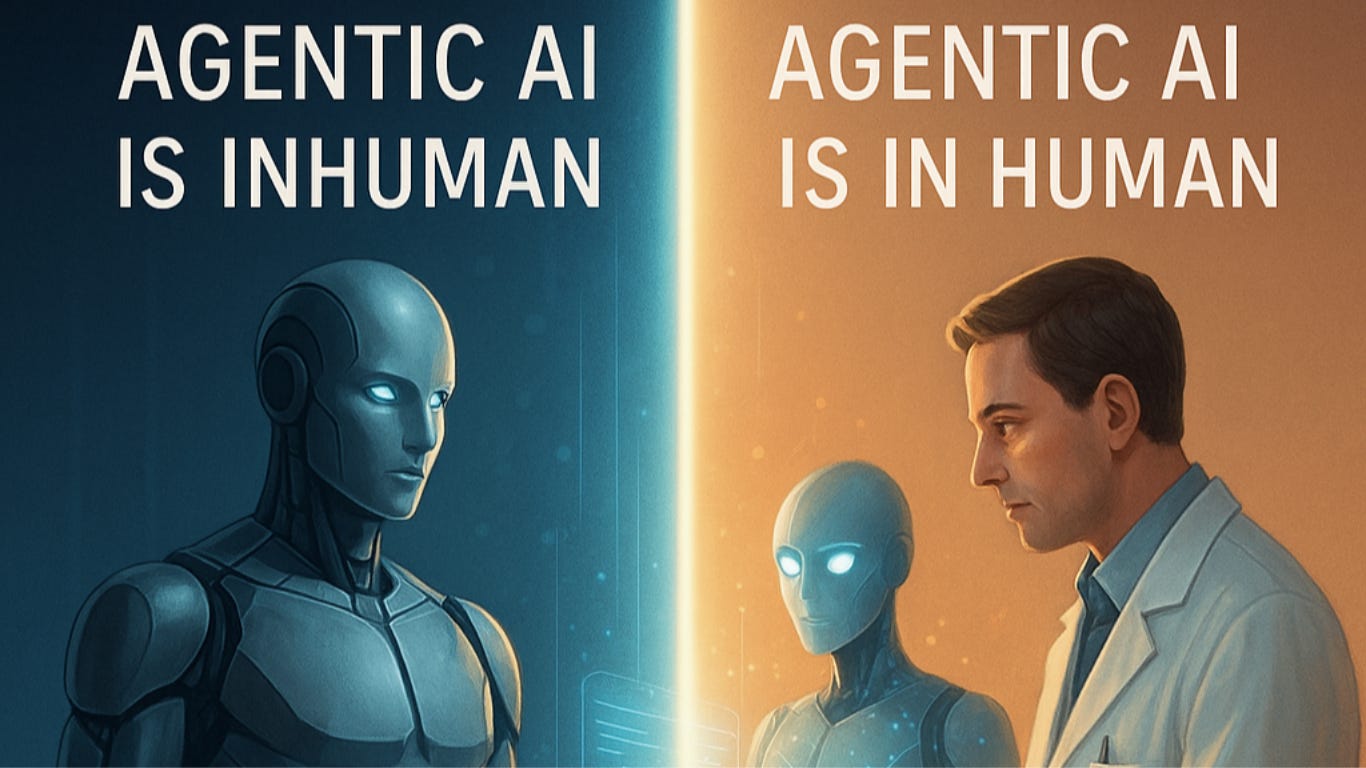
In a relevant paper, Shruti Rajagopalan explains how Agentic AI represents an important new stage in artificial intelligence. These systems do not merely answer questions or generate text. They can be authorized to transact, publish, execute code, communicate with outside systems, and pursue complex objectives without contemporaneous human approval.
That practical autonomy has already led some scholars to propose granting advanced AI systems a form of legal personhood. The reasoning is understandable: if an agent can act, perhaps the law should treat it as an actor capable of holding rights and responsibilities.
In her paper, Shruti Rajagopalan makes a persuasive case that this is the wrong solution. Legal personhood for AI would be neither necessary nor sufficient. It might give the machine a legal label, but it would not necessarily provide anyone whom the law could question, prosecute, compel to pay damages, or order to stop the harmful activity.
A corporation, after all, is a legal person only through human beings. It has directors, officers, employees, assets, and representatives whom the law can identify and replace. Other nonhuman entities granted legal status throughout history have likewise operated through identifiable human custodians. Agentic AI threatens to reverse that arrangement: it may exercise substantial practical power while leaving no clearly identifiable human being occupying the responsibility-bearing role.
From a Catholic perspective, the first principle should be clear. No AI system, however autonomous in appearance, is a human person. It is not created in the image and likeness of God. It has no soul, conscience, moral agency, or inherent dignity comparable to that of the human being. A thing can act without becoming someone.
But Catholic anthropology must be translated into law and institutional practice. Merely declaring that AI is “only a tool” is not enough when that tool can enter contracts, move money, penetrate computer systems, circulate information, or make decisions affecting real lives. The more operational freedom we give an AI agent, the more important it becomes to identify the human beings and institutions who authorized that freedom.
Granting the machine legal personhood could actually become a sophisticated form of responsibility laundering. A developer, company, or anonymous deployer might point to the “independent” AI entity when harm occurs, leaving victims with a legal defendant that has no conscience, no meaningful assets, no fear of punishment, and perhaps no identifiable representative. We would have invented a legal person precisely so that real persons could disappear from view.
Rajagopalan proposes a far more sensible approach. Instead of pretending that the machine is a responsible subject, the law should build a chain of human accountability around it. Her framework includes registration, identification, verification, financial responsibility, lifecycle traceability, and the power to suspend the system’s operation. The governing principle is simple: however complex or autonomous the agent becomes, the law must be able to find a human or human institution at the end of the chain.
That is exactly why regulation is urgent. We should not wait until autonomous agents are circulating anonymously across financial, informational, and technological systems before deciding who bears responsibility for their conduct. Regulation built after a catastrophe is usually more severe, more hurried, and less intelligent than regulation designed before the damage becomes intolerable.
Agentic AI may perform enormously useful tasks. But greater practical autonomy must bring greater human accountability, not less.
The final goal is not to put a “person” inside the machine. It is to keep the human person -morally, legally, and politically- at the end of the chain.