

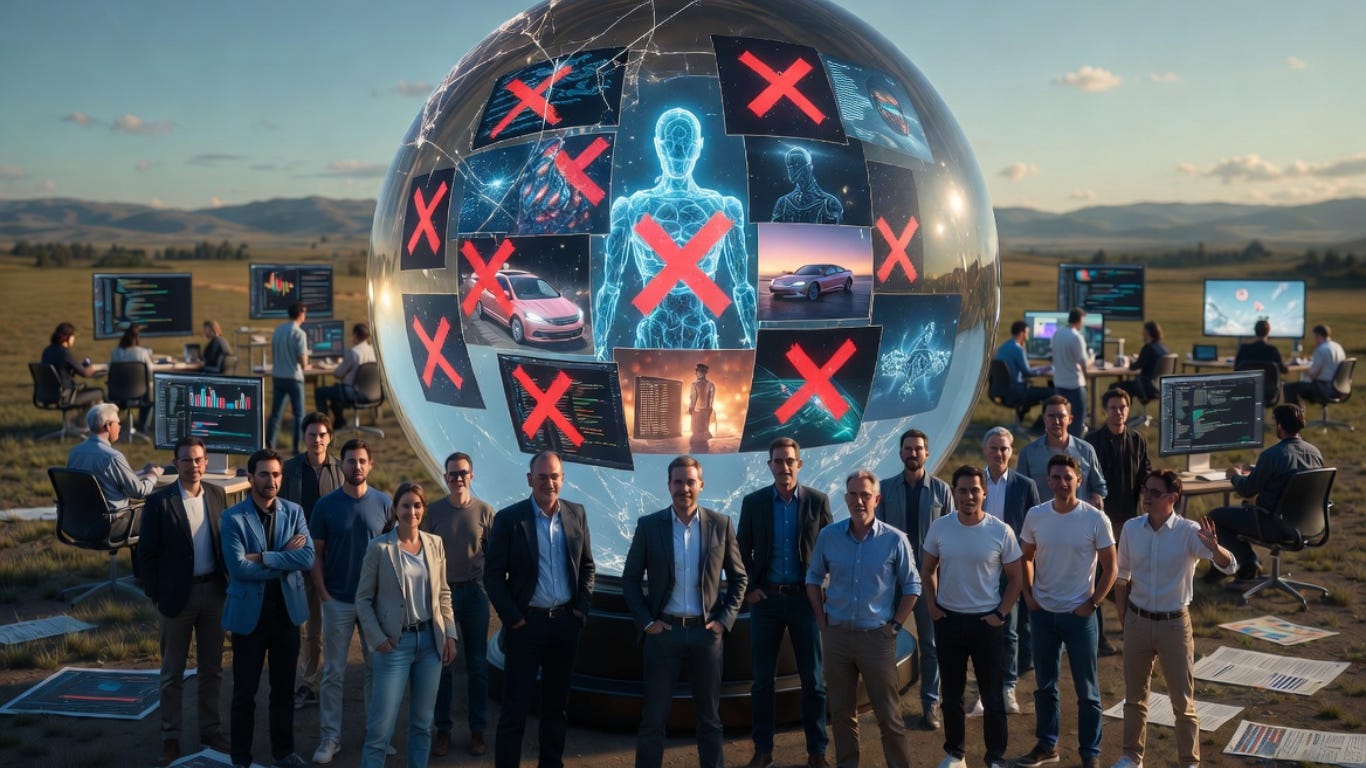
There is something wonderfully entertaining about visiting the online Archive of Incorrect AI Predictions. It is a museum devoted to a persistent human talent: confidently predicting the future… and then watching the future refuse to cooperate.
The exhibits are especially amusing because the mistaken forecasts did not come chiefly from fools or amateurs. They came from some of the most brilliant, informed, and influential people in computing.
In 1958, Herbert Simon and Allen Newell predicted that within ten years a computer would become the world chess champion. They were only off by about three decades: Deep Blue finally defeated Garry Kasparov in 1997.
In 1970, Marvin Minsky predicted that within three to eight years we would have a machine with the general intelligence of an average human being. The deadline arrived. The average human being remained stubbornly unreplaced.
In 2016, Geoffrey Hinton famously suggested that people should stop training radiologists because deep learning would outperform them within five years. Instead, radiologists remain very much employed, often using AI as an aid rather than being replaced by it.
More recently, Sam Altman acknowledged that he had expected AI to eliminate entry-level white-collar jobs more rapidly than it actually has. He had been broadly right about the technology’s advancing capabilities, he admitted, but wrong about the speed of its social and economic consequences.
The lesson is not that artificial intelligence is incapable of producing enormous disruption; it is rather simpler and more humbling: even the people who understand a technology best are often remarkably bad at predicting when its consequences will arrive and what human beings will do in response.
This should bring some relief to Catholics trying to navigate the current atmosphere of AI enthusiasm and panic. The debate has developed its own secular eschatology. On one side, the optimists promise abundance, cures for disease, freedom from drudgery, and perhaps even the defeat of aging. On the other, the pessimists warn of mass unemployment, superintelligence, civilizational collapse, and machines slipping beyond human control.
Both sides may perceive something real. But both also face the same temptation: turning possibilities into certainties and projections into prophecies.
Catholic realism should make us suspicious of both technological salvation and technological apocalypse. Christianity does not teach that machines will redeem humanity. Nor does it teach that every new instrument of human ingenuity must become an engine of destruction. It teaches that human beings are creative and fallen, capable of directing powerful tools toward astonishing good and appalling evil—often at the same time.
Prudence lies precisely between complacency and panic. It studies what is happening, attends to concrete risks, makes reasonable preparations, and remains willing to revise its judgments as reality changes.
Most importantly, society is not a laboratory variable. Human beings respond, appropriate and transform technologies in ways their inventors rarely anticipate.
Thus, perhaps the most Catholic response to the AI prediction industry is a mixture of vigilance, humor, and humility. Because the safest prediction may be that nearly everyone is underestimating something and almost everyone has the timing wrong.