

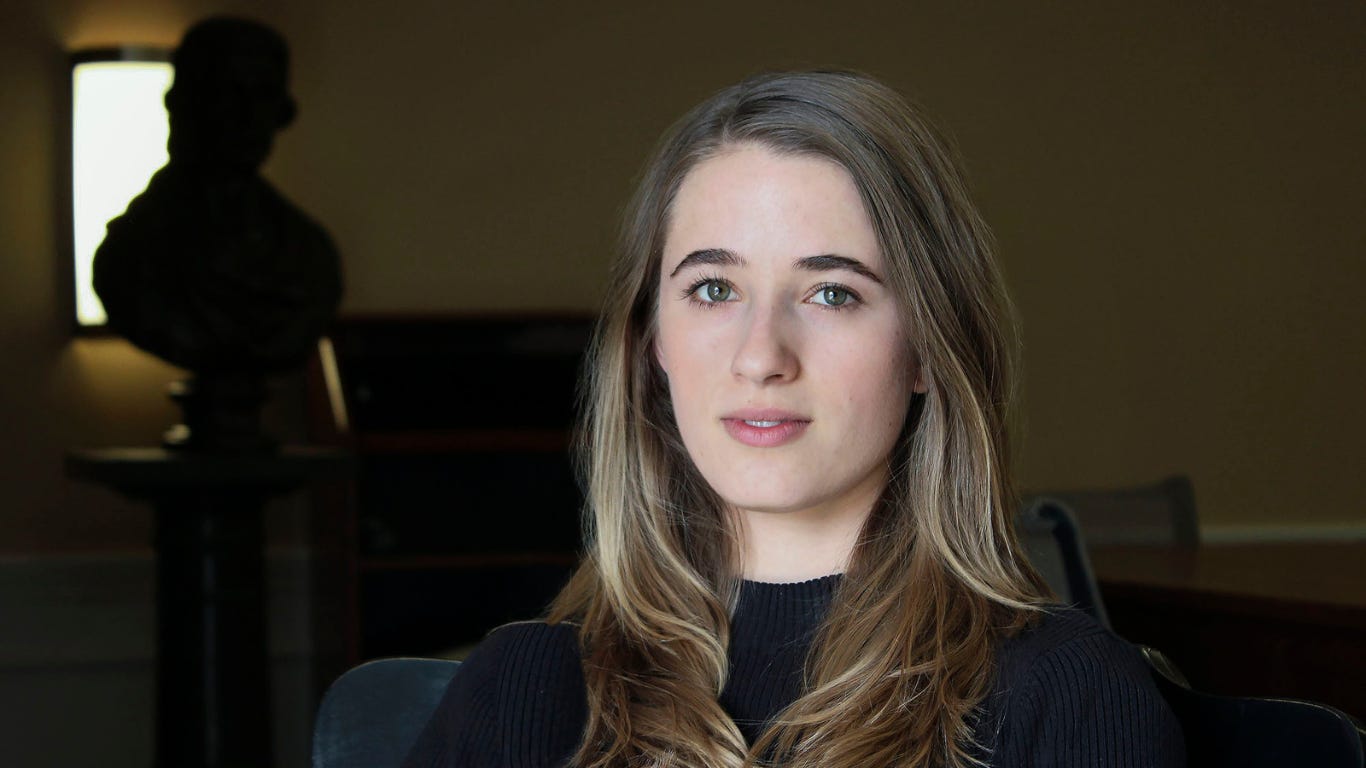
Avital Balwit, Chief of Staff for Antropic’s Dario Amodei
Avital Balwit’s essay on the Free Press titled “Searching for God in Silicon Valley” matters because it is not another outside critique of Silicon Valley. It is the testimony of an insider: the chief of staff to Anthropic’s Dario Amodei, someone embedded in the very world trying to build the future.
That alone gives the piece unusual weight. And her central insight is striking: the AI world is not simply secular, rational, and disenchanted. It has developed many of the working parts of a religion—conversion stories, eschatology, moral seriousness, schisms, and a sense of historical mission—while still failing to provide what religion gives a human being: consolation, humility, worship, and an answer to the question of how to live.
That is what makes the essay genuinely revealing. Balwit is not saying tech leaders literally think they are God. She is saying that by trying to build something of immense, even quasi-omnipotent power, they have wandered into the terrain religion has always occupied: creation, moral destiny, judgment, immortality, catastrophe, salvation. In her telling, many of these builders are not triumphant so much as spiritually unsettled. They are materialists working at the edge of questions materialism cannot comfortably answer. They are constructing systems of immense consequence while quietly sensing that the moral and spiritual frame surrounding them is too thin for the task.
From a Catholic perspective, that is both sobering and clarifying. Sobering, because it suggests the AI revolution is being driven in part by people who feel the stakes deeply yet do not possess a settled account of the good, of human nature, of humility, or of moral authority. Clarifying, because it helps explain why the Church’s voice may matter more than many Catholics still realize. Balwit’s essay is, in its own way, an admission that technical intelligence is not enough. The people closest to the machinery increasingly sense that they need wisdom, and perhaps even grace.
Her use of Chesterton is both fascinating and revealing. She sees around her a world of brilliant people who can reason powerfully about intelligence, prediction, and the future, but who remain haunted by questions reason alone does not settle. That is a profoundly Catholic insight. Man does not live by analysis alone. He needs wonder, meaning, worship, humility, and a moral horizon outside himself. Balwit recognizes that Silicon Valley has generated a kind of ersatz faith—one full of urgency and belief, but starved of transcendence.
That, finally, is why the essay is so significant for the broader AI debate. It shows that the question is no longer only what these systems can do. The deeper question is who the builders are becoming while they build them, and whether their moral and spiritual formation is adequate to the powers they are unleashing.
Balwit does not resolve that tension. But she names it with unusual honesty. And in doing so, she inadvertently strengthens the Catholic case: a civilization cannot safely develop quasi-civilizational technologies inside a spiritual vacuum and expect technique to make up the difference.