

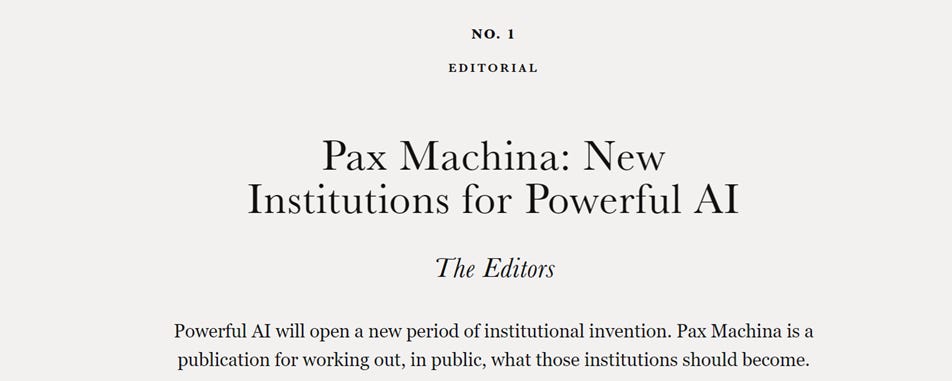
One of the most important insights in the launch of Pax Machina is also one of the easiest to overlook: if artificial intelligence is truly revolutionary, then we cannot assume that the institutions governing society can remain essentially unchanged.
That sounds obvious, but much of the AI debate still focuses almost exclusively on the technology itself. Should we slow it down? Accelerate it? Regulate it? Align it? Make it safer?
Pax Machina asks a different question: what kinds of institutions will be necessary in a world shaped by powerful AI?
The editors point out that previous technological revolutions transformed institutions as much as they transformed machines. Industrialization, for example, helped produce the modern corporation, labor unions, regulatory agencies, and mass public education. The internet revolution generated new forms of markets, reputation systems, governance, communication, and coordination.
Powerful AI will almost certainly do the same.
Existing checks and balances may prove inadequate when AI systems can operate at speeds and scales for which those institutions were never designed. Governments may gain extraordinary administrative powers. Courts, elections, media, diplomacy, and markets may all function differently when AI agents participate in them directly or when institutions themselves begin using AI to make decisions.
Pax Machina’s central intuition is therefore exactly right: institutional change is coming whether we design it deliberately or simply allow it to happen.
From a Catholic perspective, however, there is one indispensable addition. Institutional innovation cannot be reduced to mechanism design.
In other words, it is not enough to ask whether a new institution is efficient, responsive, scalable, or technically elegant. We also have to ask what vision of the human person it embodies.
Does it protect genuine human agency or quietly replace it? Does it strengthen subsidiarity or concentrate power? Does it protect families, workers, and the vulnerable? Does it preserve moral responsibility when decisions are mediated by machines? Does it recognize that efficiency is not the highest social good? And does it leave room for conscience, freedom, solidarity, and the irreducible dignity of the person?
Pax Machina itself recognizes the danger. The same AI-enabled institutions that could make government dramatically more responsive could also make surveillance and political manipulation far more powerful.
That is precisely why Catholics should welcome this conversation and participate in it.
The Church has a long institutional memory. Universities, hospitals, charitable networks, religious orders, canon law, guild traditions, and countless forms of association grew from the conviction that institutions should not merely coordinate people efficiently. They should help order human freedom toward genuine goods.
Pax Machina is right that we should begin designing those institutions now. But the drafting table needs more than engineers, economists, lawyers, and political theorists. It also needs moral anthropology.
Otherwise, we may succeed brilliantly at designing institutions for powerful AI while forgetting to design them for human beings.