

For the past several years, some of the most dramatic predictions about artificial intelligence have concerned employment.
Millions of jobs would disappear. Entry-level white-collar work would collapse. Companies would rapidly discover that a handful of employees equipped with AI could replace entire departments.
Some of that may still happen.
But one of the most important facts about the AI revolution right now is that, so far, it largely hasn’t.
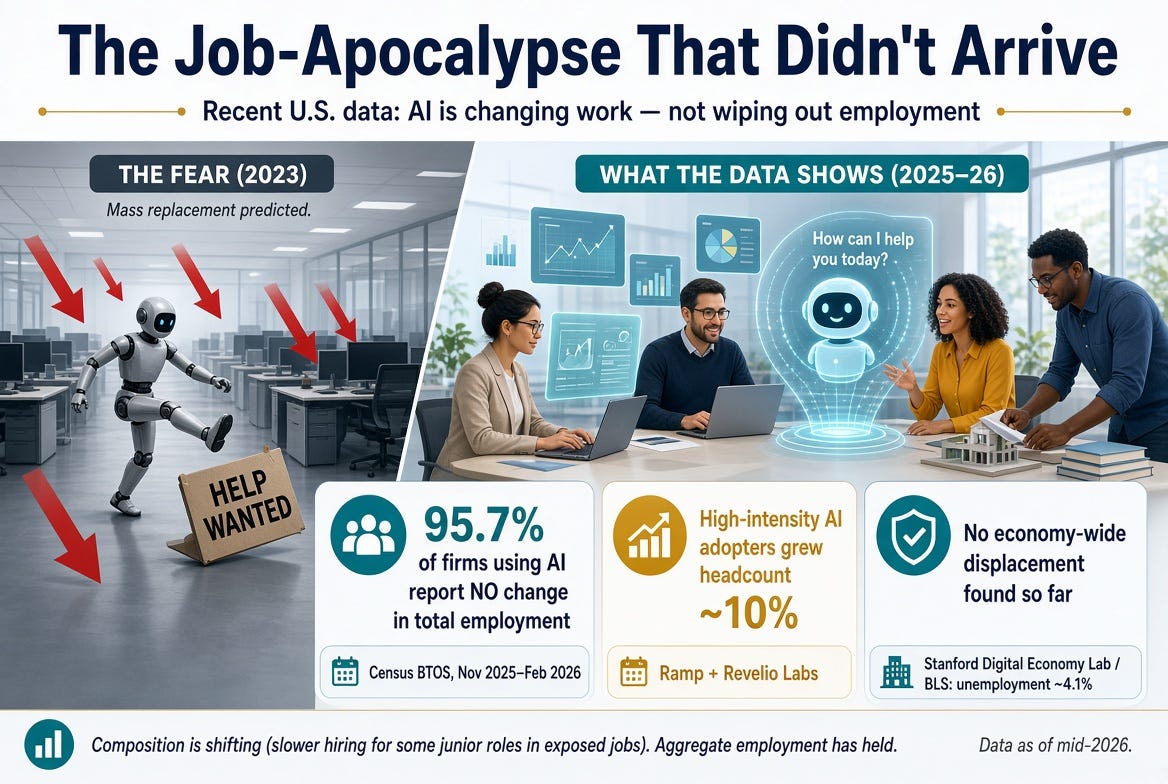
Alex Tabarrok points to unusually valuable new evidence from the Census Bureau’s enormous Business Trends and Outlook Survey. Businesses were asked a very simple question: during the previous six months, what had AI actually done to their total employment?
The answer is striking: In the latest survey, 95.7 percent of businesses using AI said it had produced no change in total employment. Only 2 percent said AI had reduced employment, while 2.3 percent actually reported an increase. Two years earlier, the results had been remarkably similar.
This does not mean AI is having no effect on work. Far from it.
Among businesses using AI, 44 percent said it was supplementing or enhancing tasks employees already performed. Only 10 percent said it was performing a task previously done by an employee, while 11 percent said AI had introduced tasks nobody had previously been doing. The underlying Census research similarly found that most adopting companies were using AI principally to augment workers rather than eliminate them.
Now, despite the good news, it is clear that this is a reprieve, not an all-clear.
Why? Because AI adoption is still developing, its capabilities are improving rapidly and the Census data already suggest greater task substitution among the relatively small group of companies using AI more intensively.
So the correct conclusion is not that there is nothing to worry about; but that we have more time than some people expected.
And from a Catholic perspective, that is exceptionally good news. Because the central question was never simply whether aggregate employment would eventually rise or fall.
Catholic social teaching asks us to look at the worker, and a technological transition that ultimately creates greater wealth can still inflict enormous suffering if millions of people lose their livelihoods faster than families, schools, companies and communities can adapt. A displaced worker is not an economic statistic waiting for equilibrium to return. He is a person with obligations, relationships, talents and dignity.
The slower-than-expected disruption therefore gives society something enormously valuable: time.
Time to retrain workers before their jobs disappear, to redesign entry-level positions so young people can still acquire skills and experience, for schools and universities to teach students how to work with AI, and for companies to discover ways to use AI to increase the productivity of existing employees rather than simply eliminating them.
The question for a business owner should not immediately be: How many employees can AI allow me to eliminate?; rather it should be: How much more valuable can AI make the people I already employ?
The second question addresses necessary productivity gains; but productivity ordered toward the person rather than the person subordinated to productivity.
That distinction is thoroughly Catholic. Work exists for man, not man for work. Technology should therefore enhance human capacities whenever possible rather than treating human beings merely as inefficient components waiting to be removed from the production process.
If companies experiment systematically and deliberately with human-AI collaboration, AI may ultimately destroy fewer jobs than predicted. Perhaps, it would create occupations that none of us can yet imagine.
What we know is that the job apocalypse has not arrived. But that is not an excuse to relax, rather, is an opportunity to prepare.