

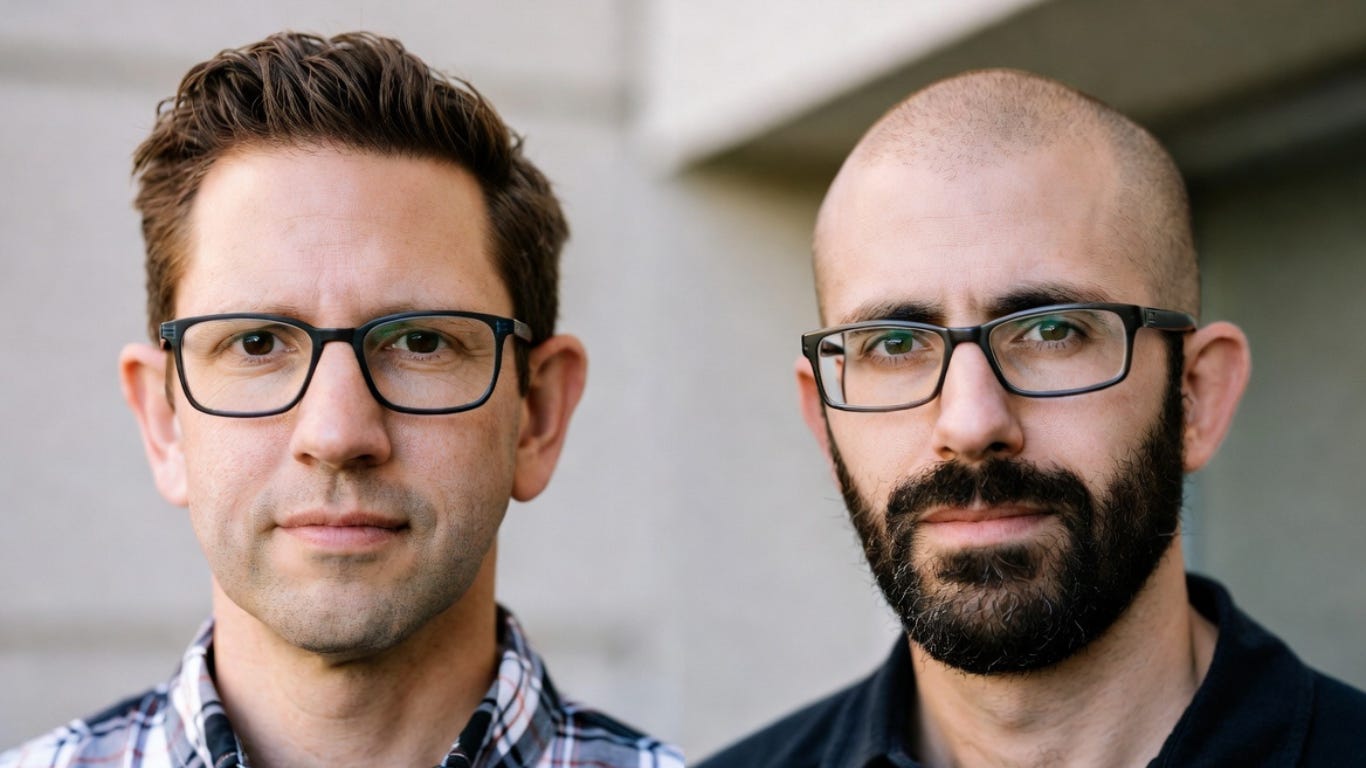
Geoff Shullenberger (left); Eliezer Yudkowsky (right) (images selected by Grok)
Geoff Shullenberger’s recent Washington Post essay may be one of the clearest summaries yet of the current metaphysical state of the AI debate.
As we know, the public discussion is currently awash with pragmatic takes on AI. Will it destroy jobs? Will it cure disease? Will it make companies more productive? Should governments regulate it? Those questions are important, but they no longer reach the deepest level of what is happening in Silicon Valley.
Shullenberger’s argument is that AI has pushed the technology world beyond questions of means and into questions of ultimate ends. Technology used to ask principally, “How can we do this?” The AI movement increasingly asks, “What should humanity become?” And once that happens, the debate inevitably becomes theological.
He traces this development through figures such as Eliezer Yudkowsky, whose early writings did not describe superintelligence merely as a useful invention but as an “Interim Meaning of Life” and even a “temporary definition of Good.” In other words, the early Yudkowsky, a strong believer in radical neo-rationalism, argued that AI ceased to be a tool serving human purposes and became itself the purpose toward which humanity is ordered.
From there, the religious parallels multiply. There are prophets announcing the coming transformation. There are rival eschatologies: salvation through superintelligence on one side -say, Peter Thiel’s side- extinction through superintelligence on the other -Yudkowsky’s current pessimism-.
There are heresies, schisms, competing sects, Antichrist accusations, visions of immortality, and even arguments that the attempt to create nonhuman intelligence resembles occult invocation.
Shullenberger’s central insight is that both the AI accelerationists and many of the AI safety advocates share an underlying premise: humanity is destined to create an intelligence greater than itself. They disagree violently about whether that event will save us or destroy us, but they often agree that it represents the decisive horizon of human history.
This is why Pope Leo XIV’s intervention is so significant. As Shullenberger notes, the Pope does not merely condemn the technological impulse. He recognizes even in the crazy dreams of “transhumanism” a distorted but recognizable human yearning for “a fuller life.”
Christianity, indeed, does not mock the longing for transcendence. It says that the longing is real; but that its fulfillment cannot be manufactured in silicon.
So, the Christian disagreement with technological messianism is much deeper than an argument over safety standards. Catholicism insists that intelligence is not the highest good, that human limitations are not engineering defects, and that salvation cannot be achieved by constructing a superior mind. Man is not an unfinished machine waiting to be upgraded. He is a creature made in the image and likeness of God, wounded by sin, called to communion, and destined for a fulfillment no technological system can provide, because it was brought by Christ.
Shullenberger ends with an important warning. The current rapprochement between religion and Silicon Valley does not necessarily mean religion will shape technology. The influence may flow in the opposite direction.
If religious institutions engage with AI without recognizing those assumptions, they may discover that they are being evangelized by Silicon Valley rather than evangelizing it.
In other words, despite the evident interest of powerful AI leaders for religion, Catholics should not mistake spiritual curiosity for conversion.
The emerging AI culture already possesses something resembling a theology: its own doctrine of human limitation, its own eschatology, its own promised transcendence, and its own competing visions of salvation and apocalypse.
The task of the Church is not simply to add Christian ethics to that technological worldview. It is to challenge the worldview at its roots.