

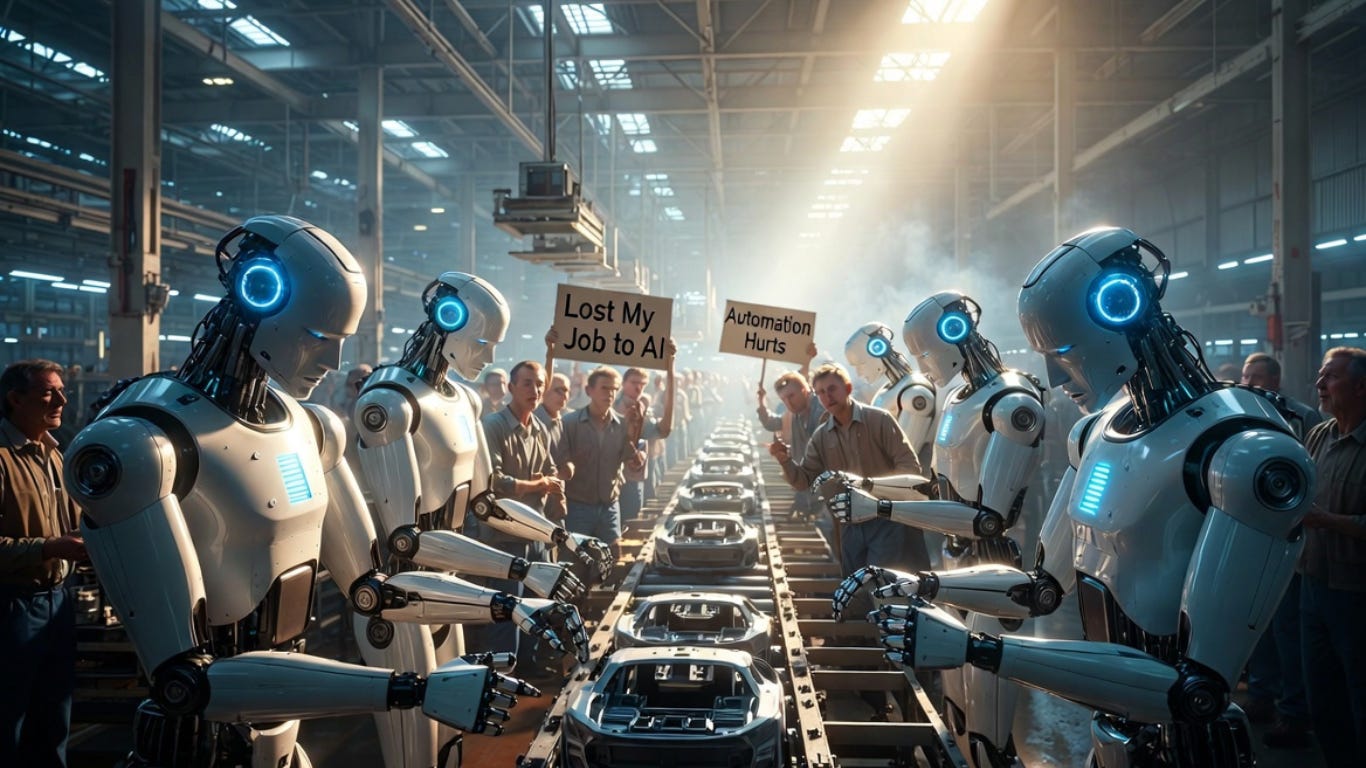
A quite revealing study authored by Hyunjin Kim (from INSEAD) and Rembrand Koning (Harvard Business School)on “AI-native” firms confirms what many preferred to treat as a distant possibility: AI is already shrinking the number of people needed to build valuable companies. Compared with similar startups in the same sectors, these firms are smaller, flatter, employ fewer entry-level workers and fewer managers, and yet create comparable value. That is not a theory. It is an early sign of the labor order AI may produce.
Catholics should not look away from that fact. In the short term, AI really will take jobs. It will narrow the first rung of the ladder for many younger workers. It will make some offices leaner, some hierarchies thinner, and some forms of knowledge work less dependent on large human teams. That disruption is not just economic. It is human. Work is one of the ordinary ways a person enters adulthood, acquires discipline, serves others, and begins to sustain a family. When technology weakens that path, the wound is real.
Our response must be to think more deeply and more boldly about what work is for. If God has given human beings the intelligence to create tools powerful enough to transform labor, then the task is not merely to mourn the old arrangements. It is to ask whether those arrangements were always worthy of the human person in the first place. Much of modern work has been exhausting, bureaucratic, fragmented, and hostile to family life. If AI destabilizes that system, Catholics should not assume our duty is simply to rebuild it exactly as it was.
The medium-term challenge is greater and more demanding: to use God-given human creativity to reinvent work in a way that is more human and more hospitable to family life. If machines can absorb some of the repetitive, mechanical, and administratively bloated parts of labor, then perhaps this disruption can become an opportunity to recover something better—work with more flexibility, more dignity, more room for craft, more space for care, more serious respect for the rhythms of marriage, parenthood, and home.
That will not happen automatically. The market will not deliver it on its own. Efficiency by itself does not love the human person. It loves output. Which means that if Catholics do not bring moral imagination to this transition, others will gladly accept a future in which fewer workers simply produce more value for the same old inhuman ends. That would be technological progress without human progress, and there is no reason to bless it.
So yes, the study suggests that AI will displace jobs in the short term. We should say that plainly. But the larger question is whether we will answer this upheaval with panic, resignation, or creativity. Catholics should choose the hardest path: neither denial nor despair, but the serious work of building a labor culture in which efficiency serves the person, not the person efficiency. If AI forces us to rethink work from the ground up, then perhaps Providence is allowing this disruption not only as a trial, but as a summons—to make work more worthy of man, and therefore more worthy of God.